
An Ancient Passover Sacrifice
In photos, then and now: 100 years of Samaritan (Israelite-Samaritan) practice
This is Life as a Sacred Text 🌱, an everybody-celebrating, justice-centered voyage into ancient stories that can illuminate our own lives. It‘s run on a nonprofit, so it’s 100% NAZI FREE. More about the project here, and to subscribe, go here:



Hag Pesach Sameach if you're celebrating!
Holy Week Blessings if you're celebrating!
April Fools if you're trolling!
I thought maybe those of us who are celebrating could get into the mood of the seder by getting a glimpse at one community's reenactment of the Exodus story.
As they themselves tell it, Samaritans prefer to call themselves B'nei Yisrael HaShamerem' ࠔࠠࠌࠝࠓࠩࠉࠌ – the Israelite-Keepers, if you will.
They trace their roots to the region once known as Samaria (now: the Occupied West Bank*). But evidently their self-identification is less the toponym ** than the word "keeper", implying of mitzvot / commandments.

**Though, yes, Samaria/Shomron has the same root as watcher/keeper/guardian; the hill on which the capital city was built may have originally been named "watch mountain."
As they tell it, the schism between the Israelite-Samaritans* and Jews happened early–they consider the biblical priest Eli (the one from the Book of Samuel) to have usurped the High Priest line and set up a rival shrine at Shiloh. (Jews obviously don't see the story that way).
Remember the business in Deuteronomy with blessings at Mount Gezerim and curses on Mount Ebal? The Israelite-Samaritans* continue to regard Mount Gezerim as their holiest site.
*Will generally go with this lower-common-denominator attribution to avoid confusion Rabbi Danya Ruttenberg
Various Jewish and scholarly understandings of the story pinpoint the split later, after the Assyrian conquest of the Northern Kingdom in 722 BCE or even centuries after.
By 1919, there were only 141 Samaritans left. Now there are over 800; half live in Holon (just south of Tel Aviv) and the other half on or near Mt. Gezerim, in what's now the West Bank. The community also makes superlative tahini, which, yes, can be bought online and in many stores in North America.

The Israelite-Samaritan Torah and the Jewish one are pretty much the same, save some words and verses here and there (all told, about 6,000 differences, but many are quite tiny). What's cool, though, is that there's a new translation of their Torah that's open source, free to download.
For our purposes today, though, what's notable is that while Jews stopped doing sacrifices with the destruction of the Second Temple in 70 CE, the Israelite-Keepers continued offering the Passover /Pesach sacrifice – slaughtering a sheep, eating it communally, and burning it– annually.
(Ethiopian / Beta Israel Jews observed this practice as well, but it's faded since leaving Ethiopia and coming to Israel. There are also Third Temple extremist zealots who dabble in this, but I try not to give them any more oxygen than necessary.)
(And yes, Christian friends, it's likely that Luke 22:8 etc. refers to this, because the Last Supper was not a seder.)
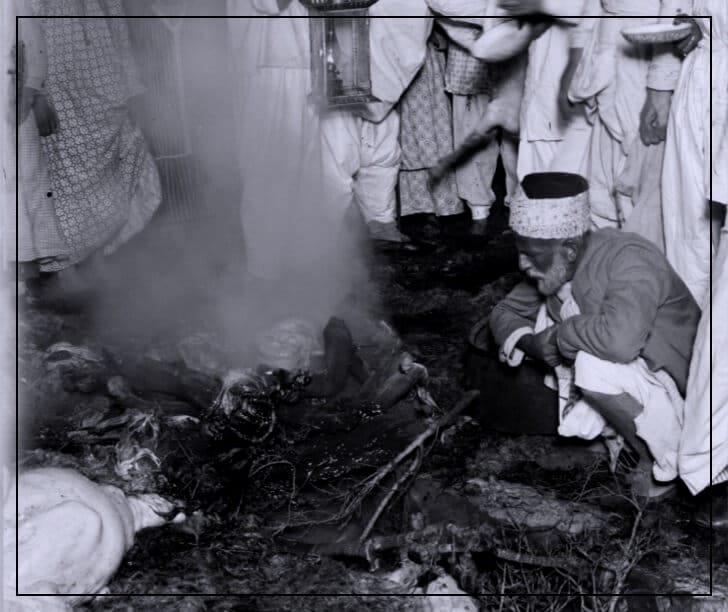
What's notable today is that we have not only photos of Israelite-Samaritan Passover sacrifices from the contemporary era, but also those dating back a century or so (!).
So please, enjoy some very cool photos of people doing things that we mostly only see written about. I'm pulling mostly from the century-old images, but there are a couple from the last few. And some Exodus verses.
Words in brackets appear in the Israelite-Samaritan Torah.That slash indicates that it's plural in the Jewish version but not the Samaritan.
A wholly-sound male, year-old lamb shall be yours; from the sheep and from the goats are you to take it. It shall be for you in safekeeping, until the fourteenth day of this month, and they are to slaughter it—the entire assembly of the community of [the children of] Israel—between the setting-times.
(Exodus 12:5-6)