
This is Life as a Sacred Text 🌱, an everybody-celebrating, justice-centered voyage into ancient stories that can illuminate our own lives. It‘s run on a nonprofit, so it’s 100% NAZI FREE. More about the project here, and to subscribe, go here:

Today we're going to break down an idea that I wish more people knew about, because it's dang useful, particularly in these times of oppression and harm:
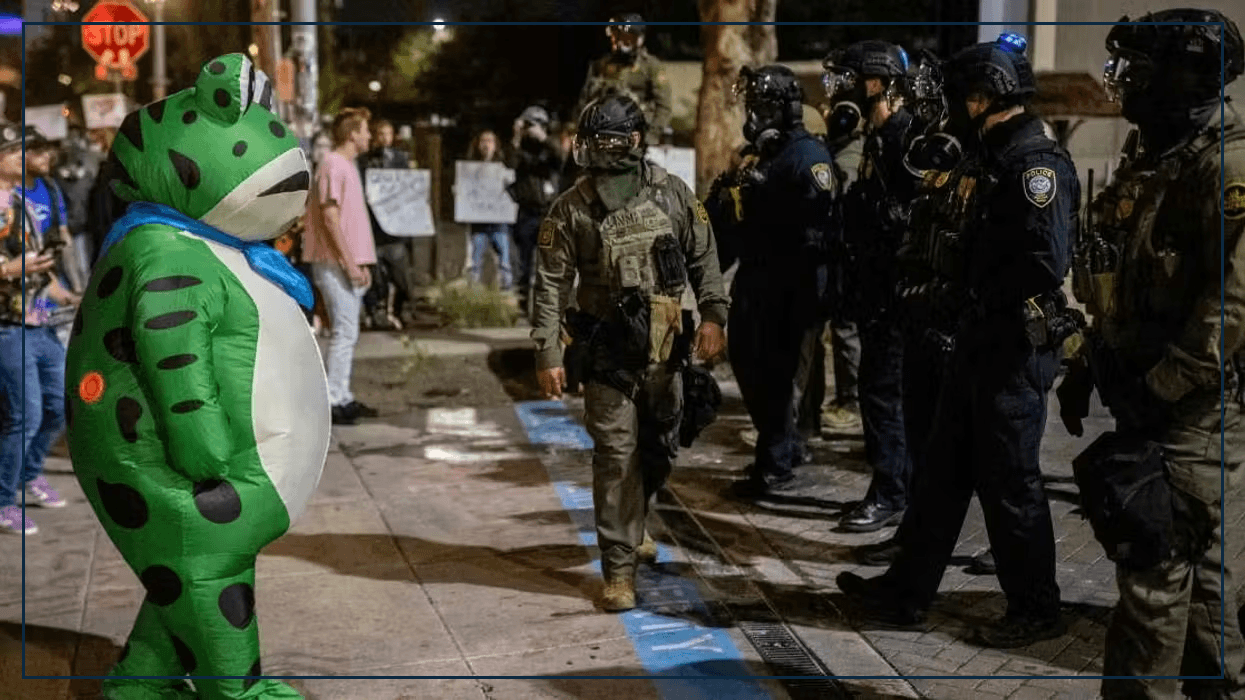
A dilemma action is a strategic action that forces your opponent into a lose-lose situation.
Basically: You've given them only bad options. No matter what choice they make, it's valuable for your goals in some way.
I'll give you some examples, and then we'll talk about how to design them.
(Please share this missive. More people need to know, OK?)


- There's long been a movement for independence of Western Sahara from Morocco. In 2011, during a period of civil resistance, there were protests against the Moroccan law forbidding the flying of the Western Saharan flag, as well as building momentum generally. So instead of letting people get targeted, activists tied flags to the tails of dozens of feral cats– forcing government police to either be humiliated chasing the cats around or to let the flags fly.

- In Burma/Myanmar, the traditional farmer's bamboo hat was the symbol for the National League for Democracy opposition party during the campaign before their 1990 elections. Theoretically, wearing this hat, the repressive ruling military authority had declared, was "subversive." But if they actually tried to arrest people for wearing a common item worn by hundreds of thousands, they'd lose credibility. But if they didn't, they'd give people a tool to openly scorn the regime. They didn't react immediately– and so wearing the hats as a symbol of resistance spread quickly, bolstering the movement and becoming important for a decade or more.
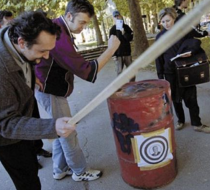
The underlying belief: People should be able to wear what they want. - In Serbia in 2000, a group of students set up a project echoing a government initiative pushing people to donate money. With the students, people could donate a dinar (the currency), and would then get a stick to hit a barrel with a photo of then-president Slobodan Milosevic. If they didn't have money because of Milosevic’s politics, could hit the barrel twice. No matter how the regime reacted, it lost: arrest the families in line, and risk spreading more anti-government sentiment, or do nothing and let the concept potentially spread? They chose Option 3: Confiscate the the barrel. So the group sent out a press release saying that the police arrested the barrel, and that they'd collected enough money for Milosevic’s retirement. (So the government still lost.)
The underlying belief: People should be allowed to have a laugh, even about the government.
- In 1982, people in a small town in Poland protested government-media propaganda by taking their TV sets for a walk. Boycotting the 7:30pm news wouldn't be visible as a tactic, and putting the TV sets in the windows every evening didn't get the attention needed. So at 7:30 each night, activists pushed TVs in wheelbarrows, like baby carriages. It was public, social and outside– a time of laughter and gossip, something that soon spread around town and to other towns. There was no law saying that people couldn't walk TVs in a wheelbarrow, so the government moved the curfew up from 10pm to 7pm, revealing that they couldn't handle critique, and outraging more of the public– thus building movement support.
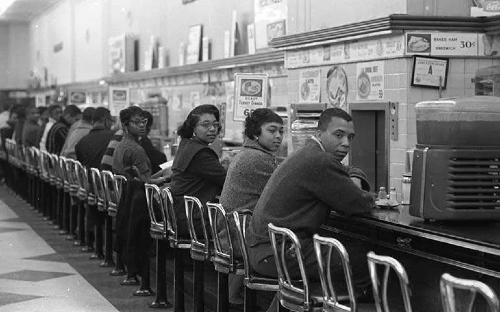
The underlying belief: People should be able to walk at night. - If you think about it, sit-ins at the lunch counters during Civil Rights were a form of dilemma action. The list of the ways Jim Crow laws impacted Black American lives is too long to list– housing, education, transportation, jobs, access to bathroom facilities, marriage, even with whom one could play cards or dice in some states. The decision to focus on something as both visible and seemingly small as buying a cup of coffee at a lunch counter– by well-dressed students holding schoolbooks and Bibles– was a great way to make sure that no matter what happened next, the opposition lost, by highlighting, visibly for all to see, the clear injustice of the law. When there was refusal, mockery, assault, and/or arrest (as there was often), media amplified the story. And while we think of sit-ins as one component of a larger movement (and they were), it's also true that as sit-ins and pressure grew, local businesses began voluntarily desegregating, states started passing statutes, and Title II of the Civil Rights Act passed Congress in 1964.
The underlying belief: People should not be arrested for trying to get a cup of coffee.
“[Dilemma actions] make you...think about what the opponent might do, and what their choices are, and select your own options in that light.”
– Scholar of dissent Brian Martin
A recent study on dilemma actions indicates that they are overwhelmingly successful:
- 84% of the time, media coverage is sympathetic to the campaign’s goals
- 87% of the time, dilemma actions reduce fear or apathy among participants
- in 93% of cases, a dilemma event boosted public sympathy for the campaign
- 88% of events succeed in reframing the opponent as less scary or more repressive
- While it's true that 90% of dilemma actions are met with some sort of aggressive or violent response from the opponent, or at least a response that makes the opponent appear like they are overreacting– and/though
- Over 50% of dilemma actions elicit some sort of concession, such as the resignation of a government official or policy change.
That's pretty good.

A good dilemma action can dramatize injustices or contradictions– making the invisible visible and changing the narrative around an issue that matters.
"Some targets tend to be more vulnerable or susceptible to dilemma actions. People with big egos, for example, are very often good targets."
– Srdja Popovic, Serbian political activist and nonviolence expert
Making authoritarians– and their agents– look like fools is can be a crucial way to undermine them.
So how do you design a dilemma action?
1) Review the opponent's policies, especially those that impact the daily life of the population. The more personal and intrusive the restrictions are, the bigger the dilemma will be for the opponent.
(Banning access to abortion and/or gender-affirming care? Banning books? Stealing human beings and putting them in concentration camps? Healthcare cuts that impact people's access to crucial medication? [Generate your own list here].)
2) Figure out which policies run most counter to widely held-beliefs, even among the people who might ordinarily support your opponent. Not just which policy, but which belief that might be deeper or could be unearthed.
3) Figure out what action would force your opponent to either give your side a clear win (an exemption to the restrictions? some other victory?) or would result in unpopular sanctions. What reaction do we want from the opponent? What would get more people on our side? Would getting respected leaders / celebs / whoever help others feel more confident in taking the risk and following?
4) After the action: Exploit the other side's response!
Make sure you have publicity (ideally set up beforehand) to get as many people activated as possible.
Whether there's a reaction or a non-reaction, whatever happens, use the other side's response. Get skillful PR people on this.
Make sure you have next steps for all these newly activated people – what do you want them to do?

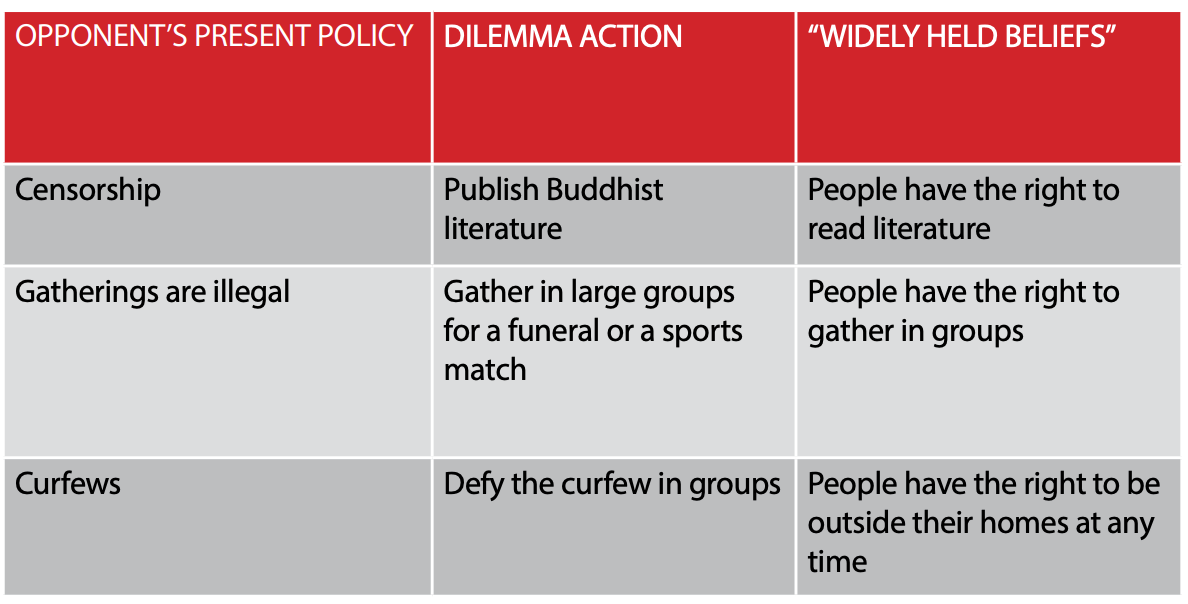
EXERCISE: Design two dilemma actions.
Draw a table with three columns.
In the far left, list a bunch of the most difficult problems that you think people are facing today.
Then, in the far right, list the widely held beliefs that contradict these policies.
In the middle column, develop a dilemma action based on pitting people’s widely held beliefs against the unpopular policies. Try to think of something that has an element of spectacle to it, that would translate for media (social and/or conventional) as indicated by many of the above examples.
Don't be afraid of the ridiculous, the silly, the funny, the wild. What could a brainstorm with the funniest mischief-makers you know generate over tea or a couple of beers?
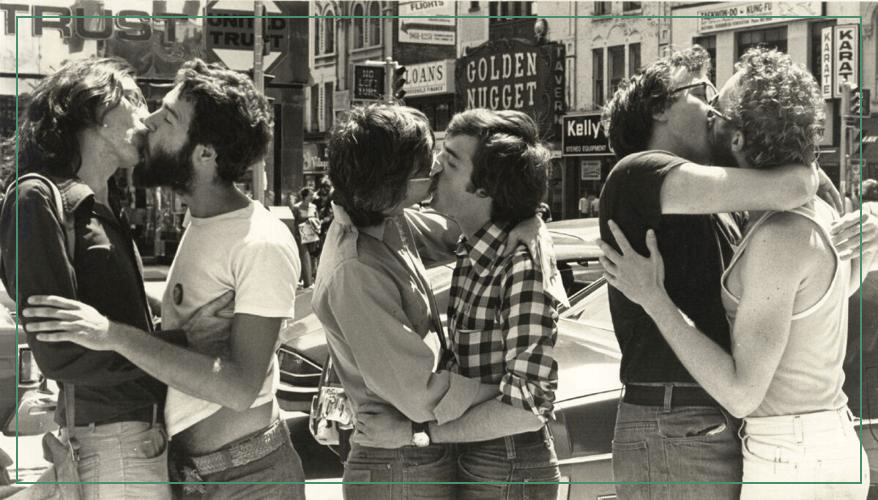
At the same token, don't shy away from gravitas when it's called for. Die-ins (and lie-ins) have been used to protest neglect of the AIDS epidemic, police violence, and much more.
Really, it's all about how far your creativity can take you. But make sure you're being strategic, thinking through what your goal is, and what the other side is likely to do in response to your actions–and where you want things to go.
That's how to get the job done.
I believe in you.
And all of us.
❤️ 🌱 ❤️
Who's one person in your life who needs to read this piece?
Send it to them.
Need some words about Life is a Sacred Text to make it easier?
How about:
- "This helps me make sense of the world when everything feels overwhelming.”
- “This is where I go for smart, humane takes on what’s happening right now.”
- “This blends history, justice, and being human in a way I haven’t found anywhere else.”
Share this post
 Share on Bluesky
 Share on Threads
 Share on Facebook
 Share on Mastodon
 Share on Reddit
 Share on LinkedIn
 Share on Email
Support independent work committed to telling inconvenient truths:
When you join our inner circle,
you become part of a diverse community of insightful thinkers and doers who care about transforming themselves and this world
-- while geeking out -- as much as you do.
This is the space you've been looking for. ❤️
For less than the price of one coffee shop drink a month.
Join us.
What, you thought there wouldn't be a resource section?!?
Of course so many people have done great homework and groundwork for us:


This is incredibly useful! But of course any tactic must be tweaked for current contexts!

More tactics! To play with, adapt, tweak, evolve, FrankenTactic, whatever!

The resources on this site are beyond amazing.
Y'all, I sent this right before Pesach / Easter (my fail, really) and because of that I don't think enough folks gave it a real look (but there's some useful stuff, is what I'm saying)
Rabbi Danya Ruttenberg
And if you're new here, these are probably useful:
Rabbi Danya Ruttenberg Rabbi Danya Ruttenberg
 Rabbi Danya Ruttenberg