
Moral Injury
Or: Why We Need The Prophets Now, More Than Ever
This is Life as a Sacred Text 🌱, an everybody-celebrating, justice-centered voyage into ancient stories that can illuminate our own lives. It‘s run on a nonprofit, so it’s 100% NAZI FREE. More about the project here, and to subscribe, go here:

Life is a Sacred Text is finally entering our Prophets Era.
It will be, as I've intimated, a bit meandering, non-linear, but I want to introduce some overarching ideas that I'm hoping will inform this whole next epoch of this project, and our work together.
And at the same time, I'll share a much newer framework that can illuminate so much of our individual and collective harm now, and, I think, drive home the need to ground and reground in these ancient texts.
Let's talk about moral injury. And the prophets.
Prophets were found throughout the cultures of the Ancient Near East. They were typically either based at the local temples and/or hired by their local kings, and more or less told those kings what they wanted to hear: You should go to war, you shouldn't go to war, and so forth.
While some biblical prophets did have features of these sorts, there were other features that seem to be more or less distinctive to The Prophets Of The Bible™️, insofar as we know. (We'll get there.)
The word for prophet in Hebrew is navi– literally, "one who has been called." They were originally known as "seers," and their domain covered dreams and divination as well as serving as the sacred telecom center.
Thus said the Sovereign God... You partake of the fat, you clothe yourselves with the wool, and you slaughter the fatlings; but you do not tend the flock. You have not sustained the weak, healed the sick, or bandaged the injured; you have not brought back the strayed, or looked for the lost; but you have driven them with harsh rigor.... (Ezekiel 34:2-4)
That is, the prophet was literally the intermediary between the divine and the people, often passing on messages from the former to the latter. This included (now we're talking biblical prophets) advocating for God's vision– of what must be –to the people (sometimes / often, to those with power) and sometimes advocating on behalf of people to the divine, to Ultimate Power.
And prophets were always engaged with the events of their contemporary moment.
The Hebrew prophets that we know about were, for the most part, independent. It's not a coincidence that their stories and teachings are so often populated with stories about – and words on behalf of – those struggling to get by. When you read the prophets, you see, again and again, widows, people who are sick, and those affected by famine and oppression. When there are miracles from God– for, sometimes they are miracle workers– the people who are on the receiving end aren't wealthy. This isn't a coincidence. It's a statement of priority and value.
Hear this word, you cows of Bashan... Who defraud those who are impoverished, who rob those in need...my Sovereign God swears irrevocably: behold, days are coming upon you when you will be carried off in baskets.... (Amos 4:1-2)
They had a lot to say about the Temple and other official systems and structures that guided daily life. They weren't opposed to them as a rule, but they put ethics and morality at the forefront. And in all the places where ethics and morality clashed with official matters, there wasn't a question about what would win:
Care for human beings, always. Justice. Righteousness. Kindness. Integrity.
Do you value independent voices speaking uncomfortable truths?
Support Life is a Sacred Text so that we can keep doing just that.


These seem like far-away concepts now, don't they? The Syracuse Moral Injury Project defines moral injury as
the damage done to one’s conscience or moral compass when that person perpetrates, witnesses, or fails to prevent acts that transgress one’s own moral beliefs, values, or ethical codes of conduct.
[This includes] the lasting emotional, psychological, social, behavioral, and spiritual impacts of actions that violate a [person's] core moral values and behavioral expectations of self or others.
The term itself is believed to have come through the writings of Vietnam War veteran and peace activist Camillo “Mac” Bica and psychiatrist Jonathan Shay in the wake of warzone trauma. As the prophets themselves indicate, this is an ancient problem– now articulated in the language of our day.
Moral injury has been described as a "deep soul wound," and that people in authority failing to do what's right is a particularly egregious contributor to it.
One study summarizes the kinds of situations that have shown to result in moral injury:
1) Acting (or failing to act) in ways that violated one's own moral code or values
2) Feeling betrayed by leaders or colleagues who one once trusted
3) Seeing/witnessing things that were morally wrong
.... You might see where I'm going with this, don't you?
In these days of horror and genocide, these days in which leaders and institutions of trust all too often choose cowardice or cruelty, complicity with white supremacy and the persecution of marginalized communities–
... in which too many people experience their own communities under attack, watch those on whom they had depended fail to step up, or just don't believe that anyone has their back and sides–
... in which always-fragile policies protecting people from discrimination and harassment have been jettisoned in many spheres, leaving even more people open to and experiencing harms (while others are forced to make hard choices about complicity) –
... in which we are still learning about how many people have, and continue to, cover for powerful leaders who sexually assault(ed?) stolen girls (children) for their own entertainment–
... in which more people are struggling to get by because of the actions of those in power.
In which, on the off-chance that we or those we love are not personally impacted, we carry devices everywhere from which we can bear witness these harms to those who are sick, hungry, and subjugated.
If you do not oppress not the immigrant, the fatherless, and the widow, and do not shed blood in this place or walk after other gods to your own detriment, then will I cause you to dwell in this place... for ever and ever. (Jeremiah 7:6-7)
Certainly, not all moral injury is the same. Those on the front lines of war experience things that someone feeling fear and empathy on their phone does not. As does a healthcare worker forced to make unjust decisions about human life because of the brutalities of a for-profit and/or under-resourced system; those who experienced betrayal by "institutions of trust," and so forth. (On the more significant end of the spectrum, it's been formally recognized as a mental health condition.)
But I wonder if we're not all living in a culture of moral distress and injury, and if it might not help to at least begin to name this.

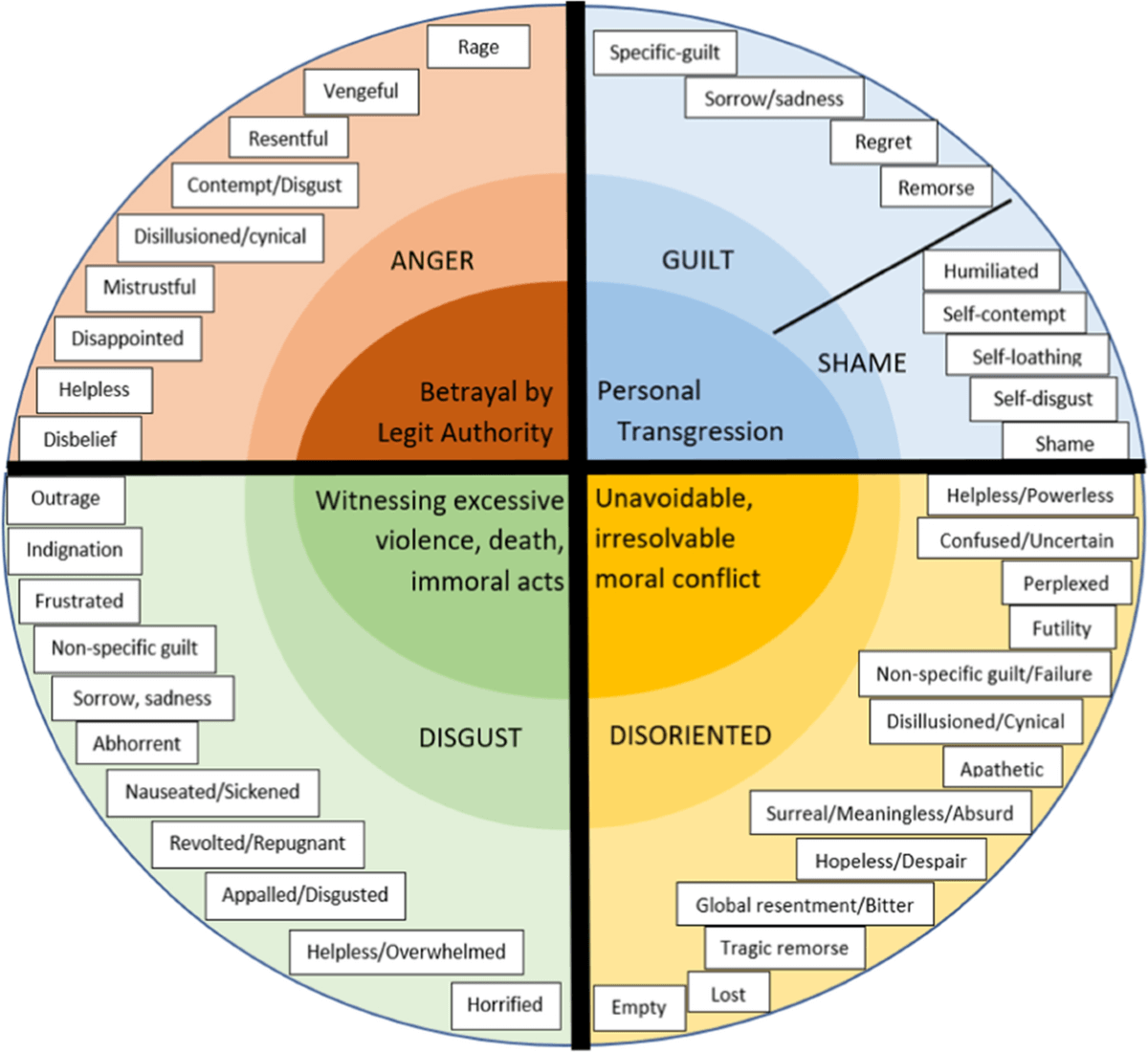
Someone named Wesley Fleming created the Moral Injury Experience Wheel to help people identify their feelings:
There are a lot of different treatments being suggested for moral injury, but the patterns I've observed after looking over a bunch of them seems to be– and none of these are that surprising, really:
1) Articulating the harm
2) Talking about it with others– both trained professionals as well as others who've gone through the same thing– and having your experiences witnessed non-judgmentally and validated
3) The work of – yep – repentance and repair. That may include accountability work, self-compassion, forgiving others (or choosing not to), and more.
4) Work on rebuilding one's own sense of values and integrity, including taking actions towards living those values. (This is honestly very much part of the repair work.) Finding ways to help others is listed as a key component.
5) Being in healthy community is important, too.
(Depending on the harm, trauma therapies like EMDR, exposure therapy and CBT are sometimes used as well.)
The teachings of the prophets arose in times of great moral harm and danger.
Your rulers are rogues and cronies of thieves; every one avid for presents and greedy for gifts. They do not judge the case of the orphan, and the widow’s cause never reaches them. (Isaiah 1:23)
And they are, I believe, absolutely essential tools to us now, in this era of moral distress and injury– guidelights out of the fog of relativism, out of a haze that follows money and power wherever it shall lead, that has lost any reverence for the sanctity of life and honor for the dignity of our fellow human.
The prophets promoted both self-criticism and hope: Their message was, again and again: You can and must do better. Justice will prevail.
And, yes– however we might think of it today, their message was, often: God’s hand is in history, and in the long run, God will support the good and undermine the bad. And nevertheless! We have a role to play. We must do our part, or else.
The role of the prophet was to help us see that what is now is not what must be. And to help us figure out how to get there.
Over the next number of months, we'll begin to get into the Prophetic section of the Hebrew Bible. We'll go via Joshua and Judges, because there are a few worthwhile and/or important things to engage with there, and then we'll start digging into prophetic stories by I Samuel.
And, as promised, all this will be interspersed with other things– for example, there's a multi-part American history series (one that illuminates some of the painful things about now, too) that I've been looking forward to launching.
But the prophets are coming– because we need them, and their wisdom, so urgently today.
You have been told, mortal, what is good, and what God requires of you: Only to do justice, and to love goodness, and to walk humbly with your God. (Micah 6:8)
If you value this work, if you think having an independent moral voice matters now, sign up for a paid subscription.
This is a community-supported publication, and it only functions when the people who value it show up for it.
And as always, House of Study access is always available if paying isn't for you right now; life@lifeisasacredtext.com and we'll hook you up.
Share this post
 Share on Bluesky
 Share on Threads
 Share on Facebook
 Share on Mastodon
 Share on Reddit
 Share on LinkedIn
 Share on Email
Please remember that, without Substack's built-in network, we need the community – you – more than ever to amplify conversations. Thank you. ❤️

A SPECIAL TRAINING FROM OUR FRIENDS AT EDUCATEUS ACTION
Elected officials answer to us so let's hold them accountable and remind them who is in charge! EducateUS is proud to host Feminist Generation for their "How to F*** With Your Elected Officials" training, so that we can all learn the strategic tactics and tools necessary to mount pressure campaigns on elected officials across every level of government and win.
February 26, 2026 7:30 PM - 8:30 PM ET
Support independent work committed to telling inconvenient truths: