
Hag Sameach to everyone who's celebrating! (Holy Week blessings to those of you honoring that time!) (Have a great day to everybody else!)
I first shared this a number of years ago, but for a number of reasons (some of which will be revealed AFTER Passover!), it feels Correct to re-up it this year.
And at the bottom are some NEW Pesach sources and resources.
No leaven shall be found in your houses for seven days. For whoever eats what is leavened, that person shall be cut off from the community of Israel, whether they are a non-citizen or a citizen of the country. (Exodus 12:19)
One of the commandments associated with Passover is that of removing chametz, leaven, from one's domain.
In contemporary practice, this involves not removing pasta and cookies from the cupboard, but also cleaning everything (especially the kitchen), taking out dishes on which leaven has never been eaten, and a lot of other things.
It's a rigorous, physically demanding process of cleaning, wiping, boiling, and sorting, but at the end of it, as Passover starts, there's often a gorgeous feeling that one has purified, in a way, one's physical surroundings.
The act of preparing for Passover can feel deeply spiritual in its way, but it also invites us to ask whether we're removing the spiritual leaven from our lives as well as the physical stuff.
A lot of traditional commentators describe leaven as puffy and swollen—think of bread rising. They talk about spiritual chametz as the puffy parts of our ego—the way we try to posture and preen, to be someone in the world (or in the room) rather than just existing as we are, being gentle and modest, a mere humble matzah.
We see this humility vibe with the 19th c. Lithuanian Rabbi Naftali Zvi Yehudah Berlin (Netziv),
Matzah takes no advantage of the human technological ingenuity which allows humans to raise the dough more than simple flour and water which are created by God... (Haamek Davar on Exodus 13:3:4)
And a clear statement in this contemporary tome:
"The second type of pride, which the prohibition of ḥametz on Pesaḥ is designed to root out, is a person’s pride vis-à-vis their Creator….(Peninei Halakha Pesach Chapter 1)
These commentaries tell us that in this season, we must ask ourselves: Where are we too proud? How are we too puffed out? How do we take up too much space?
Where do we try to show the world how big we are? When do we—wittingly or unwittingly—take up so much room that we make it harder for others to shine?
I feel.. complicated… about this metaphoric field. It's provocative, and certainly relevant enough to me personally.
But on the other, well—unfortunately, things haven’t changed as much as they should have by now. There are feminist questions that can enter the conversation to teach us something else about what chametz is, and how it can get us to liberation.


25 years ago, Carol Lee Flinders wrote a book called At The Root of This Longing: Reconciling a Spiritual Hunger and a Feminist Thirst. She’s a scholar of medieval Christian women mystics who’s spent most of her life in a meditation center/community that she helped found, studying with a student of Gandhi’s. So she’s got a broad (though not Jewish) perspective on spirituality, and a deep feminism (even if, published as it was in 1998, it made some assumptions that we might nuance and transform today). (Jews, where she says "monastic contexts," perhaps you might hear, "away at yeshiva," or "doing practices towards bittul ha-yesh."* (I'd like you to consider this next quote in light not only of our own communities, but of this contemporary political moment.)
She writes,
“Formulated for the most part within monastic contexts, [precepts of spiritual practice] cancel the basic freedoms—to say what one wants, go where one likes... to be somebody—that have normally defined male privilege. That is, men in any given social class have always possessed these liberties to a far greater degree than women of the same class....Women, on the other hand, have not [traditionally] been in a position to renounce those privileges voluntarily because they never had them in the first place.... [The advice given in mystical literature] sound[s] remarkably like the mandates young girls have always received as they approach womanhood and that, in veiled forms or under tacit threats, they still receive.”
In other words, a select group of people have always been allowed to—encouraged to, told to—take up space. So trying not to take up space—to work on humility, to be less “puffy”—is a significant spiritual task for them.
✨ Upgrade your Life is a Sacred Text subscription now! ✨
✨Get all the archives! ✨Get all the Thursday text studies and bonus conversations (in your inbox or online!) ✨Join our monthly Zoom Salons! ✨ Support the labor that makes accessible learning happen! ✨
For just about everybody else, after a lifetime of don’t talk so much in class; why are you so aggressive; cover your body; ugh pushy bitch; fat bitch; stop bragging; shut up, that didn't happen to you; don’t show off—
being given the spiritual assignment of, “Now you have to take up less space,” is like, “oh, good, something new, someone thinks we have to work on humbling ourselves and making ourselves smaller in order to be acceptable. How novel.”
It, shall we say, hits different.
So then what? Because the choices of
a) Forcing everybody else to reenact the harm they’ve endured their whole lives, but now wrapped in “spiritual growth project” is not how we get to wholeness or holiness.
or
b) Saying, “OK, everybody else you are therefore off the hook of doing work to grow into more whole and holy people. You can sit on the couch instead of striving for connection.”
are not so hot.
But there are always other options on the table.
The root חמץ —Ch-m-tz—really comes from “sour”; you can see how one can get from “sour” to “fermenting,” right? But the thing is, the word also goes from “sour” (and vinegar) to “harsh” and then to “cruel.”
Which is why Isaiah 1:17 reads,
“Learn to do good. Devote yourselves to justice; show up for the chamotz [oppressed/one who has cruelty done to them]. Uphold the rights of the orphan; defend the cause of the widow.”
Chamotz—the one who is oppressed, who has cruelty done to them. Chametz, here: the one in the state of being oppressed/the one in the state of having cruelty done to them.
So getting rid of chametz would be, perhaps, a twin endeavor. Both to search out the places where we have been, are, the one who brings this sourness, harshness, cruelty to the world.
And perhaps to also see and attend to the ways in which we have had cruelty done to us—the hurt places. The grudges to which we are finally willing to let go. The traumas to which we need to attend, lovingly.
Rebecca Raphael observed that it’s a problem even to frame chametz as a “vice,” since most of us happily enjoy chametz the rest of the year.
The chametz we’re clearing out is last year’s sourdough starter—that’s what the deal was, back in the day. So it’s what’s overgrown. What isn’t serving you anymore. How you’re not serving yourself.
Maybe it’s about the inner work we need to do to let go of whatever it is that’s keeping us from acting as our best self in the world.
There’s always a reason for that.
Maybe it served us for a while. But it’s not serving now. It’s time to go, so that you can begin to allow the next level of your growth to come in.
I think we think about ‘vices’ in the wrong way, sometimes.
It shouldn’t be: “Stop being so puffy and proud!!”
But, rather: “Honey, what’s going on that you are trying to impress people in that way? What’s the hurt underneath the insecurity?
Go there.
Revisit the old pain, spend some time inside it, and see what you understand from your wiser perspective now.
See what of that can be healed.
What you can let go.
How you can go a time deep in it and emerge with space for the new thing that you will be. M’gn’ut ad shevach. מגנות עד שבח. From pain to glorious expansiveness.
Let go of the old chametz. It’s not only not serving you, it’s a problem for you now.
But it’s not just about our pain and letting go.
It’s also about taking responsibility.
We must name the ways in which we are both harmdoers—to see it, to own it—and to recognize the pain underneath that needs attention.
It’s true that, unlike the crumbs on the floor, we don’t always see our illusions about ourselves, the ways in which we take shortcuts on our integrity and deepest values. There's no cabinet in which we can lock away our pettinesses and our meannesses for a week. But there’s also no place to store the pain that might be driving that sourness, the pain we cover over with harshness because it’s easier than facing. That’s buried somewhere way deeper than underneath the couch.
We have to seek all of it out.
Like the search for physical leaven, we must be intentional in our attempts to collect all of the parts of who we've been that are not nourishing, that are dragging us down.
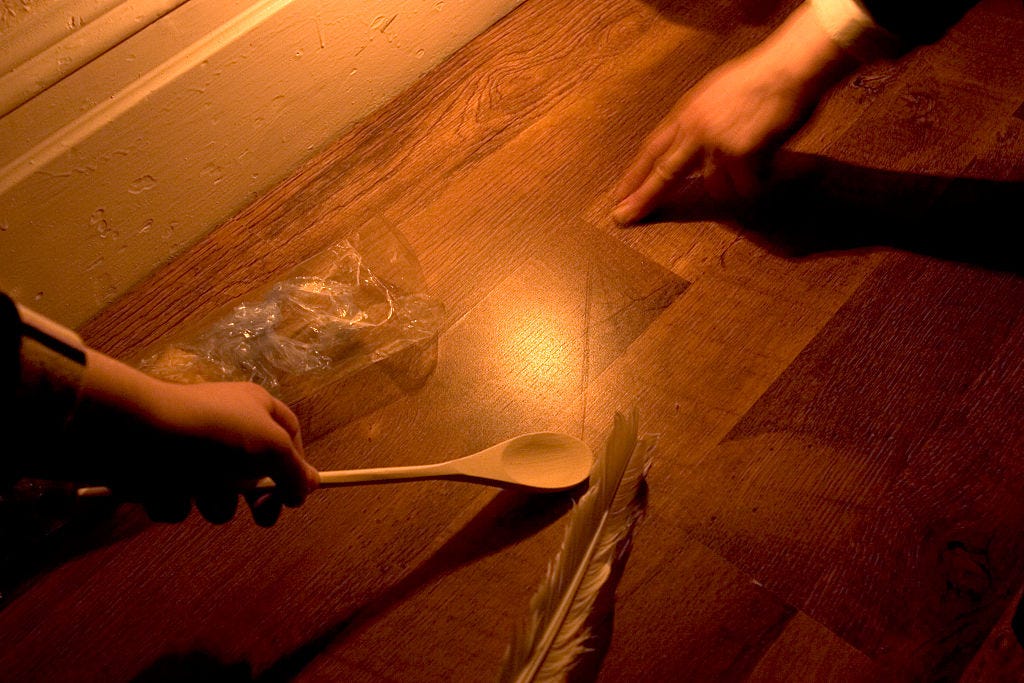
We must be willing to confront it; name it; pull it out from where it's been hidden all this time.
This work requires tremendous bravery.
And it's work for people of all genders.
It’s not about not taking pride in who you are—unless and until that pride puffs into hubris.
It’s not about silencing your voice—unless and until that voice brings harshness and cruelty to others, at which point quietness and recalibrating are in order.
It’s not about no longer shining big—unless and until you no longer make room for others.
When you subscribe to the Life is a Sacred Text House of Study, you get extra sustenance for your heart, soul and brain and every week.
Isn't it time to invest in the parts of you that matter most?
We all have work to do.
But it’s not all the same work.
The ways we are cruel and sour in the world take many forms, and the root causes of that harshness come from many different forces, both social and personal.
And then, when we find it, we must burn it, just as Jews traditionally burn their leaven on the morning before the Passover seder. We have to give it up completely, to let it go, to transform ourselves by putting the worst of who we have been on the pyre.
We know, on some level, that like the cookie crumbs that always seem to linger under the sofa, some of our oppressive tendencies might come creeping back. But it is the act of seeking it, naming it, and releasing it, to committing, year after year after year, to purifying the self and becoming the holiest version of who we are meant to be—it is the work of seeking out and releasing our internal leaven that is, in itself, an offering to the great transcendent beyond.
And Isaiah reminds us:
“Learn to do good. Devote yourselves to justice; aid the chamotz [oppressed/one who has cruelty done to them]. Uphold the rights of the orphan; defend the cause of the widow.”
This work of seeking out our own deepest places of cruelty is tied up in the larger work of creating a more whole world. Of fighting for the rights and safety of all marginalized people.
When we release the chametz within ourselves, we learn to do better.
We can then devote ourselves better to justice. As we clean ourselves of harm, we can then turn to removing harm everywhere.
This, truly, is the work of the season; the journey to liberation.
❤️ 🌱 ❤️
Share this post
 Share on Bluesky
 Share on Threads
 Share on Facebook
 Share on Mastodon
 Share on Reddit
 Share on LinkedIn
 Share on Email
You make Life of a Sacred Text a community—a movement.
! share the love // get some love !
Share your unique link with anyone who needs nourishment, truth and hope.
Share it on social media, in your chat groups, on listservs, anywhere and everywhere.
Get Life is a Sacred Text swag, signed books, and a shoutout in my next tome!
Support independent work committed to telling inconvenient truths:

It's literally cheaper than one fancy drink a month!
$6? You kidding?
But you get
-Weekly deep-dives with nourishing, transformative text!
-Ask the Rabbi sessions!
-Asynchronous community!
-Get matched with a study partner (if you want)!
-Access to FIVE YEARS of archives!
-To support the labor behind this project!
⭐ To feel so much more supported and cared for! ⭐
MORE PESACH SOURCES AND RESOURCES:






 Rabbi Danya Ruttenberg
 Rabbi Danya Ruttenberg
 Rabbi Danya Ruttenberg
 Rabbi Danya Ruttenberg
 Rabbi Danya Ruttenberg
 Rabbi Danya Ruttenberg