Persevere.
Making change needs consistency, just like everything else

This is Life as a Sacred Text 🌱, an everybody-celebrating, justice-centered voyage into ancient stories that can illuminate our own lives. It‘s run on a nonprofit, so it’s 100% NAZI FREE. More about the project here, and to subscribe, go here:

When I was in my mid-twenties, one of my teachers was Zoketsu Norman Fischer, former co-abbot of the San Francisco Zen Center. He was the best friend of my rabbi, Alan Lew (z"l), and co-taught at the Jewish meditation center that Lew founded 25 years ago.
I was excitable, impulsive; Fischer had the opposite energy. On a retreat one time, he mentioned that the quality he most valued in others was persistence.
The older I get, the more I come back to this. Especially now.
Especially as I think about our work for liberation.*
(MANY RESOURCES at the bottom of the post.
Including Passover resources! Don't sleep on them.)
Many of you may have been at the No Kings action yesterday. (Not all of you were able, of course, and always: there are so many ways to show up and they're not all the same). If you were: I hope your experience was moving and empowering.
And: this moment when you might be riding high is a great time to talk about the importance of persistence and diverse tactics in social justice work.
We're all overwhelmed. Too often people get activated for a week or two by the news, or something like No Kings happens, but eventually the demands of Everything Else sucks us back in until the next major escalation, and then the cycle begins again.
This is, needless to say, not a strategic way to fight the kind of harm we're facing.
As I mentioned a over a year ago, the way to defeat fascism involves
1) a cross-section of the population engaged in
2) diverse tactics,
3) sustained over time.
Sustained.
"There is a myth that creating deep seated social change is somehow all about winning … organizing is all about resilience. – Emily May
And as always, the question of what can each of us do that is sustainable is important. Because we must keep steady, no matter how easy it is to get knocked off-course.



The fact that we've now been plunged into war, taking God knows how many innocents before this is all done, means that it's more important, not less, that we not give up now. Despair is a luxury and a privilege that many people do not have.
We have tools. We can do this.
We have to show up, and keep showing up.
Movements are growing. But momentum matters. Which means that we need as many people finding a regular discipline in our resistance practice, whatever that looks like.
One of the great weaknesses of our era is that we get lone superhero movies that suggest that our big problems are solved by muscly guys in spandex, when actually the world mostly gets changed through collective effort.
–Rebecca Solnit on her new book, The Beginning Comes After the End
As I say often: We need all hands on deck, and there's a lot of deck.
Even in the realm of fighting the system, there are a lot of roles one can occupy.
To say nothing of direct care for those most impacted; changing culture through education and other means; building new systems for tomorrow; making change through institutional channels, and, yes, funding it all.
Whatever your role, it must be a regular, ongoing, steady discipline.
(This is not to say: You shouldn't pause and refuel as needed. You must! Including seeking joy. But "pause and refuel" is different than, "wander away until another protest happens back onto your radar." Dig?)
So with that, a few reminders and a few tips for this moment:
"I don’t like that man, I must get to know him better." -Abraham Lincoln

Relationships, Relationships, Relationships.
In this post-post-pandemic, increasingly polarized world, we've gotten out of the habit of engaging with people who prompt any kind of internal discomfort, I think.
Yet the building-block of organizing is the relationship.
I'm not saying that you should seek out teatime with someone who wishes for your annihilation or of those you love (and I'm not talking about unrepentant harmdoers given many opportunities to do better.)
But I am saying that the real work of solidarity also involves real human beings, and even on a good day, people and relationships are messy and complicated. All the more so if those people are not exactly like you, which is crucial in movement building.
How can you, in this moment, not only build more relationships across lines of difference, but also build resilience when things (inevitably) get bumpy? To be dan l'kaf zechut, as we say, to give someone the benefit of the doubt (literally, "weigh the scale in their favor" [Pirke Avot 1:6]) and lead with curiosity instead of reactivity? This isn't: Never have boundaries. But: where is this person coming from? What's informing their perspective? What information might you be lacking? Where might empathy, even around a topic of disagreement, be a fruitful starting point? What are alternatives to walking away? And if it turns out that you can't work together on this thing, what can you work together on?
More on getting involved with work, and figuring out your lane, here.
A diversity of tactics. Really.
I keep saying this: Protests are important AND we must go in from many angles.
We know boycotts work: cancellations to Disney+ after Kimmel was suspended likely got him reinstated. Target's CEO had to quit and they've seen corporate layoffs, plummeting stock, and decreased sales after rolling back DEI policies. Then there's Tesla. Etc.
All you religious and spiritual types reading, ritual in the public square and other related tools at hand can be part of how you raise prophetic voices. And if you're part of a congregation or community, that's a built in network to mobilize (and if you're a layperson with progressive clergy, hopefully they're already on it and can help plug you in).
But, like– there are so many modalities. So many! Political scientist Gene Sharp outlined nearly 200 methods of nonviolent action, (and many more have emerged since then, especially given technology.) For example:
- Reluctant or slow compliance!
- Creating alternative social institutions!
- Stunts! Pranks! Mock Awards!
- "Haunting" officials! Noise barrage!
- Guerrilla theatre! Protest art!
There are a list of 190 more methods at the bottom of this missive!
Get creative. Get weird. Get psychological. (Two quick case studies):
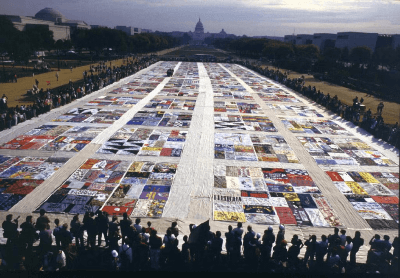
During the bad old days of the AIDS crisis, the display of the AIDS Memorial Quilt– such a soft, caring object– on the National Mall in 1987 was pivotal in both confronting lawmakers with the humanity of those dying from their neglect and raising awareness about the pandemic. Not applicable to this moment, but it was an effective way of forcing engagement with an issue that power wanted to ignore.
I've told this story before: Claude Cahun, the queer nonbinary French-Jewish photographer, was living on the island of Jersey, when Nazis turned it into ground for training soldiers. Cahun and their partner, Marcel Moore, slipped anti-fascist poems into the pockets of soldiers' uniforms at the laundry. They wrote fake letters in German, urging new recruits to desert, and left them under windshield wipers. They stole propaganda posters and cut them up into resistance flyers, which they hid inside cigarette boxes and left around town for soldiers to find.
Destroying morale looks like a lot of things in 2026. Those tiktoks of people heckling ICE agents? Making it hard for them to get their Chipotle in peace? Yep.
AND: What other skills and tools might you, or your people have?
What will help address the war in Iran?
Federal power grabs? Election tampering? The Epstein files?
Or is getting involved with Indivisible or something else via Mobilize more your speed? Just show up, keep showing up.
Make it sustainable.
What's your game plan for integrating this work into the rest of your life?
What's the cadence of your activism going to be? The ways in which it flows with rest, refueling, and all your many other obligations? Sit down with a calendar and maybe one of your trusted people to help you figure this out. You can.
All of us, together.
We can do this.
❤️🔥
Resources at the end!
Click through the email (or check the website) to get them!
Share this post
 Share on Bluesky
 Share on Threads
 Share on Facebook
 Share on Mastodon
 Share on Reddit
 Share on LinkedIn
 Share on Email
You make Life of a Sacred Text a community—a movement.
! share the love // get some love !
Share your unique link with anyone who needs nourishment, truth and hope.
Share it on social media, in your chat groups, on listservs, anywhere and everywhere.
Get Life is a Sacred Text swag, signed books, and a shoutout in my next tome!

It's literally cheaper than one fancy drink a month!
$6? You kidding?
But you get
-Weekly deep-dives with nourishing, transformative text!
-Ask the Rabbi sessions!
-Asynchronous community!
-Get matched with a study partner (if you want)!
-Access to FIVE YEARS of archives!
-To support the labor behind this project!
⭐ To feel so much more supported and cared for! ⭐




And the comprehensive list of methods of protest, here:


 Rabbi Danya Ruttenberg
 Rabbi Danya Ruttenberg
AND! HAG SAMEACH, EVERYONE ❤️
Have a Pesach of liberation if you're celebrating (and a joyous Easter if you're celebrating that!)





 Rabbi Danya Ruttenberg
 Rabbi Danya Ruttenberg
 Rabbi Danya Ruttenberg
 Rabbi Danya Ruttenberg
EVEN MORE BONUS CONTENT BELOW!
Support independent work committed to telling inconvenient truths:

Judaism & Reproductive Justice: Birth Control and Abortion in Jewish History & Ethics three-week course on Tuesdays with Judaism Unbound, Tuesdays starting 4/14, 3:00-4:30 pm ET / 12:00-1:30 pm PT.
Financial aid is available; more on the registration page.
BONUS CONTENT:
As usual, there's more here than I was able to include, and as usual, there's some important stuff that I didn't want to cut. This time, I wanted to move us more quickly through the conversation about how bad things are to get to the conversation about what to do, but there's some important stuff here, too.
Come and learn:
White Americans keep looking to 1930s Germany for lessons on authoritarianism, but they ignore Black Americans who have survived it here. Slavery, Jim Crow, and racialized state violence are forms of American authoritarianism.
— This Is NOT Business As Usual (@jemartisby.bsky.social) 2026-01-13T21:22:17.842Z
White Americans keep looking to 1930s Germany for lessons on authoritarianism, but they ignore that Black Americans have survived it here. Slavery, Jim Crow, and racialized state violence are forms of US authoritarianism
Too important for a caption, honestly:
The phrase "America First" was used frequently by the Ku Klux Klan after WWI, when they were 5 million strong, and by other racist groups. (Remember, Trump's father seems to have been in the KKK.) William Randolph Hearst also used the phrase in his newspapers. In the 1930s, Hearst praised and interviewed Hitler, and ran columns by Hitler, Mussolini, and Göring. In 1940, the America First Committee was comprised of antisemitic MFs like Henry Ford (who Hitler complimented in Mein Kampf) who opposed getting involved in "Europe's wars" and stopping the Holocaust. Trump's embrace of the phrase, starting in 2015, is no accident.