

This is Life as a Sacred Text, 🌱 an everybody-celebrating, justice-centered voyage into ancient stories that can illuminate our own lives.
It‘s always human-authored, and it's run on a nonprofit, so it’s 100% NAZI FREE. More about the project here, and to subscribe, go here:
This newsletter is a reader-supported publication.
Paid subscriptions allow our tiny team to keep doing this work.
If you want in to the House of Study but paying isn't on for you right now, reach out and we'll hook you up, no questions asked. Always.

“Shtus (nonsense, folly) is shtus, but the academic study of shtus is scholarship."
-Talmud scholar Saul Lieberman introducing Kabbalah scholar Gershom Scholem before a 1957 lecture at the Jewish Theological Seminary. (Whatever you do or don't think about Kabbalah, come on, this is hilarious.)
Over the years, a number of folks have asked me to teach about Kabbalah and Jewish mysticism, and I've decided that the best way to do that might be to actually connect the dots over history, so we're going to do a four-part House of Study SERIES!
I'll share some history, but also texts, and as always, questions for discussion for you to bat around with your hevruta/study partner (and I'll include the hevruta request form below if you're ready to get in on this), with a friend, a group, or to ponder by yourself and to share in the comments!
This week we'll look at the earliest post-biblical texts; next week we'll unpack a key Kabbalistic concept or two; the week after that we'll look at some possible roots of the "surprising" flowering of European Kabbalah and the Zohar; and then, lastly, we'll look at some of the ingredients that made 16th c. "Tzfat Kabbalah" the unique thing that it was– and dispel a common myth.
This is a Thursday post meant for House of Study members,
and a special Five Year birthday gift to you.
🎁
To get the rest of the series --
and the rest of the ongoing House goodies-- subscribe now.
To begin really at the beginning: As some consider it, Kabbalah began when prophecy ended. That would begin the Jewish mystical timeline around 500 BCE.
From then time until 900 CE or so, two main mystical streams emerged.
One is Rabbinic: Maaseh Bereishit (Acts of Creation) detailed secrets of Creation and time-before-Creation, and Merkavah (chariot) mysticism used the model of Ezekiel chapters 1 and 10 (check the links to see the original, mind-bending stuff) to access a mystical “chariot” through the seven palaces in Heaven. (Connected to Merkavah, is Hechalot ("palaces") literature, mystical texts about entering Heaven alive.)
What does this look like?
Until here, you have permission to speak; from this point forward you do not have permission to speak, as it is written in the book of Ben Sira: Seek not things concealed from you, nor search those hidden from you. Reflect on that which is permitted to you; you have no business with secret matters....
Now is there not from the earth to the firmament a walking distance of five hundred years, and the thickness of the firmament itself is a walking distance of five hundred years, and a similar distance exists between each and every one of the firmaments? And above them, above all the firmaments, are the divine creatures. The feet of the divine creatures correspond in distance to all the firmaments; the ankles of the animals correspond to all of them, the shins of the animals correspond to all of them, the knees of the animals correspond to all of them, the thighs of the animals correspond to all of them, the bodies of the animals correspond to all of them, the necks of the animals correspond to all of them, the heads of the animals correspond to all of them, and the horns of the animals correspond to all of them. Above them is the Throne of Glory: The feet of the Throne of Glory correspond to all of them, the Throne of Glory corresponds to all of them, and the living, almighty, lofty, exalted Ruler dwells above them.... (Talmud Chagigah 13a)

- Why is the Talmud telling us not to speak? What's that about, do you think?
- What do you make of the various aspects of Chariot Math, above?
- (How thick is the firmament? What are we trying to figure out? Why are we talking about the bodies of animals and their thighs and divine creatures and what do you make of the fact that we ultimately land at the Throne of Glory?)
- What else do you notice about this text?
Share this post


And then there's one that's probably (?) outside the Rabbis' sphere (heh): Sefer Yetzirah, the Book of Creation.
On one level, it details the mystical meanings of the 22 letters of the alphabet and their role in Creation, treating them as the building blocks of the universe:
“God engraved wisdom's thirty-two wondrous paths with three linguistic books (sfarim): with text (sefer), with numbers (sefar), and with communication (sippur).” בשלשה ספרים בספר וספר וספור
(Sefer Yetzirah 1:1)
- How does this opening parallel the opening of the Torah?
- I'd ask about the use of "wisdom" here but instead I'll just tell you: This is a link to ancient wisdom traditions and yet the beginning of what later Kabbalists will call the Shekhina, the immanent, indwelling divine.
- How does the word "engraved" work as a metaphor for Creation?
- Why do you think the text opens with this particular alliteration on the level of its surface meaning?
- On the level of the deeper meaning, it's also an allusion to the concept of the sefirot– don't worry about that now, we'll get into them more next week.
- On the level of the deeper meaning, it's also an allusion to the concept of the sefirot– don't worry about that now, we'll get into them more next week.
And from there, Sefer Yetzirah goes even harder:
Twenty-Two Letters of Foundation—Fixed in a wheel with 231 gates. The wheel turns back and forth. This is a cypher for the matter: There is nothing in goodness higher than Delight ( oneg / ענג ) , and nothing in evil lower than Affliction (nega / נגע ) . (Sefer Yetzirah 2:4)
The idea with this is that if you connect each letter to every other letter you get 231 connections, and it creates a wheel that looks like this (which, some have pointed out, can look like a sphere from a top view, if you squint; do with that as you will):
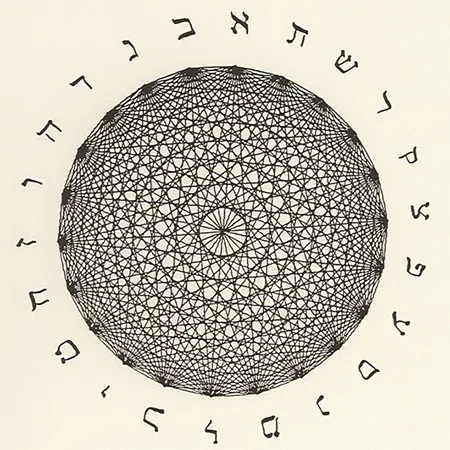
These "gates" are both access points from the human to the divine, symbols of metaphysical energy, and a lot of other things. The wheel, too, can spin in two directions– life-giving ("delight") or destructive ("affliction"). Creation isn't a static event. It's ongoing. (Are you beginning to see how this works? It's wild.)
Most people think Sefer Yetzirah probably dates between the second and seventh centuries. Some suggest that it's a response to the destruction of the Temple in 70 CE, focusing not on the sanctity of Torah as the Rabbinic tradition did, but on using text to access a cosmic Temple that could be found everywhere.
One scholar, looking at how it uses letters, suggests that it's probably from the seventh century in a Syriac Christian culture, probably (what's now) southeastern Turkey. Another suggests that it's from the ninth century Muslim world.
Everybody agrees, though, that by the ninth century it was pretty solidly crystallized and regarded as pretty authoritative in the Jewish world, and began to circulate around the Jewish world, even as far as Europe. And whether or not they were written to be in relationship originally, people began connecting Sefer Y and Hechalot literature.
And though (obviously) the date of this passage below and when it got inserted into the Talmud is something people debate– Sefer Yetzirah landed quite the cameo in the Talmud:
Rav Ḥanina and Rav Oshaya would sit every Shabbat eve and engage in the study of Sefer Yetzira, and a third-born calf [igla tilta] would be created for them, and they would eat it in honor of Shabbat. (Talmud Sanhedrin 65b)
Mmm, golem steak dinner.😋 (What would you magic up if you could manipulate letters into Creation?)
Share this post
Aaaand I think that's a good stopping point, don't you??
Now, look back at those questions above and share some thoughts!
(The one that looks like this: 💬)
Subscribe now so that you can get the whole series!
RELATED:
Here's more on Sefer Yetzirah and artist Victoria Hanna's exquisite art from it:
 Rabbi Danya Ruttenberg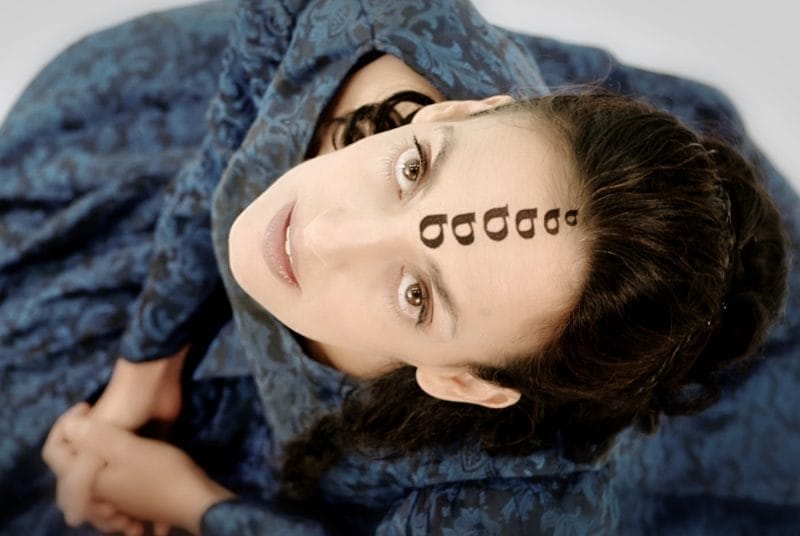
Other takes on mystical practices:
 Rabbi Danya Ruttenberg
 Rabbi Danya Ruttenberg
❤️ 🌱 ❤️
Who's one person in your life who needs to read this piece?
Share this post
Support independent work committed to telling inconvenient truths:
HOUSE OF STUDY MEMBERS!
- Ready to be paired up with a hevruta / study partner?
- Have requests for topics to cover in future Thursdays?
- Have other comments or notes about House of Study or LiST in general?
👇👇👇


Did you know that you can now buy House of Study gift subscriptions for the people you love
(and also the ones you just kind of like pretty OK)
all year round??
Delight the folks who need inspiration and fortification while supporting independent media and enabling more community work to come!
Win! / Win! / Win!