
This is Life as a Sacred Text 🌱, an everybody-celebrating, justice-centered voyage into ancient stories that can illuminate our own lives. It‘s run on a nonprofit, so it’s 100% NAZI FREE. More about the project here, and to subscribe, go here:

As many of you know, about a month ago Pope Leo issued an encyclical –a special letter to bishops– on the use of AI. There, he wisely noted that though technology is neither “a force antagonistic to humanity” nor “inherently evil,” it can certainly be problematic when used badly. And, he continued:
“In the era of artificial intelligence, when human dignity is threatened by new forms of dehumanization, ours is the pressing duty to remain profoundly human...."
He called on the tech industry to avoid
“the idolatry of profit that sacrifices the weak.”
As a result of these, and other statements– about AI's environmental impact, the importance of slowing the pace of its adoption, and more– more people have begun looking for religious exemptions to AI use at work – both Catholics and non-Catholics (for example, this Unitarian Universalist). And civil rights lawyers are on standby.
Now Microsoft has laid off 4800 employees because “AI is changing how work gets done” (despite Zuckerberg admitting that a similar move may have been folly); it’s been revealed that older employees are 25% more likely to be pushed out for this; and the number of job listings involving AI use are surging.
A few people have asked me for this, and it seems like time:
The Jewish case for an AI exemption at work.
IMPORTANT CAVEAT:
Don't say you didn't read this, OK. What's below is not an argument for a ban on all AI use in all contexts.* In addition, I agree with those who note that we must also talk about cloud computing, Zoom and other aspects of data center work. Ultimately, what we need is regulation and policy change– just as we can't focus solely on individuals recycling while ignoring the fact that the Pentagon is the largest single consumer of fossil fuels in the world.
Rather, this piece offers an argument for some religious (Jewish) grounds under which an individual worker might request a reasonable accommodation from a job-related obligation or expectation to use AI. It also, I believe, makes a case for why Jewish individuals and organizations might consider thinking twice about the cavalier use of generative AI.**
*Even asking that question would demand a much more thoughtful, considered engagement with the technology and literature than I am able or willing to do at this time.**Again, I'd like to table conversations about assistive tech for disabilities, use of AI for medical research, and much more for some other time.
Title VII of the Civil Rights Act makes it illegal for
"an employer... to discriminate against any individual with respect to [their] compensation, terms, conditions, or privileges of employment, because of such individual's race, color, religion, sex, or national origin; or... otherwise adversely affect [their] status as an employee, because of such ...."
Nobody would think twice about demanding a reasonable accommodation if corporations asked Jews to start violating Shabbat or partaking of the pork BBQ at the company retreat against their own practice. And while I would not demand that every Jew request such an accommodation (for Shabbat or keeping kosher), they should absolutely have that option available, even if their religious practice is a work in progress. So too, here.
And despite seeing many people (including religious Jews!) eliding the moral and religious issues around AI because "that train has already left the station," we should make choices based on whether they are right or wrong. Also, it's a fallacy: Movements grow from dissent. College students are already pushing back against AI use and God willing we'll change who's holding power very soon (speedily, and in our days). And the fact that the immediate response to the papal encyclical was a groundswell of people looking for religious exemptions was telling. We all decide what train tickets to get.
So, why might a person need a religious accommodation in order not to use AI at work?*
1) It's forbidden to benefit from theft.
As you may know, AI models (whether ChatGPT, Midjourney or etc.) don't get information from nowhere. They scoop up profound amounts of data from the Internet, and their responses to people's prompts are based on what they've already stashed in their proverbial pockets, which was taken from the labor of real people (many of whose livelihoods now at risk as a result of all this.) Here's a baking metaphor, if it's helpful.
As it happens, I'm one of the many authors whose books (half a million of them!) were stolen by Anthropic AI. After a judge ruled that our work was pirated and a class action lawsuit could go to trial, they settled out of court. Legally: theft. Judaism isn't a fan of the practice.*
*To clarify, since some folks seem to be confused. That a gigantic corporation settled out of court rather than experience the judicial consequences of its actions is not amends; it is legal strategy, and ignores the systemic questions that include ChatGPT, Grok, and most importantly the many, many smaller writers and artists whose work has been taken without consent even if they do not have the same kind of Formal Publisher Standing to pursue their legal rights the way the plaintiffs in this case did. And since smaller creators do not have the resources to take on these literal billion and trillionaires, what LLMs are doing is not entirely settled law yet-- but as one data specialist online noted, by the time it is more universally recognized as theft, it will be too late. (The analogy used was that once, there was a belief that land was fair to take, and now there's an understanding that we settlers stole land from Indigenous peoples.) Also, viz the harmed authors in our case, one kind of financial reparation does not mean that they are exonerated from their impact--there are many steps to meaningful tshuvah, of which amends (settlement to avoid consequences no less) is just one.But! You might say! I'm not stealing the work! It's already stolen! All I'm doing is entering in some words and asking it to make me a picture!
As Rabbi Cantor Jessica Lynn Fox put it,
Copyright and intellectual property protections in Jewish law go back at least to Talmudic times, when we read in BT M’gillah 15a: “And Rabbi Elazar further said that Rabbi Chanina said: Whoever reports a saying in the name of one who said it brings redemption to the world.”
More than that, it's forbidden to benefit from stolen goods. To wit:
Sefer HaChinuch, an important work from thirteenth-century Spain:
It is forbidden to benefit from one about whom it is assumed that all that they have is from stolen property. (Sefer HaChinukh 229:4)
From there, the authoritative 16th c. law code the Shulchan Aruch:
Anything that is assumed to be stolen, it is forbidden to acquire/take it. And so, if the majority of that thing is stolen, we don't take/acquire it. (Shulchan Aruch Choshen Mishpat 358:1)
And after that, a digest of the Shulchan Aruch summarizes a few things:
It is forbidden to derive the slightest benefit from that which was stolen or robbed while it is in the possession of the thief or robber. (Kitzur Shulchan Arukh 182:9)See also, eg (eg Talmud Beitza 29a, Mishneh Torah, Robbery and Lost Property 13:11, etc.)
Is the thief the the AI generator, the CEO of the company, profiting off the theft, or the company's shareholders? I'm not sure, at the end of the day, that it matters, for "that which was stolen" is still in their possession, helping the "thief or robber" to generate a profit.
2) Using generative AI without attribution is fraud.
I'll just hand the mic to the Central Conference of American Rabbis for this one:
If [a] rabbi claims to be the “author” of a poem without indicating that it was produced using AI, the congregation will hear the rabbi saying that [they] produced original content... To not make that difference clear is to engage in onaat d’varim (verbal fraud) or g’neivat daat (deception). Both of these are strenuously prohibited by our tradition.....
There are many sources on both onaat devarim and g'neivat da'at within the tradition; the link above lists a number of them.



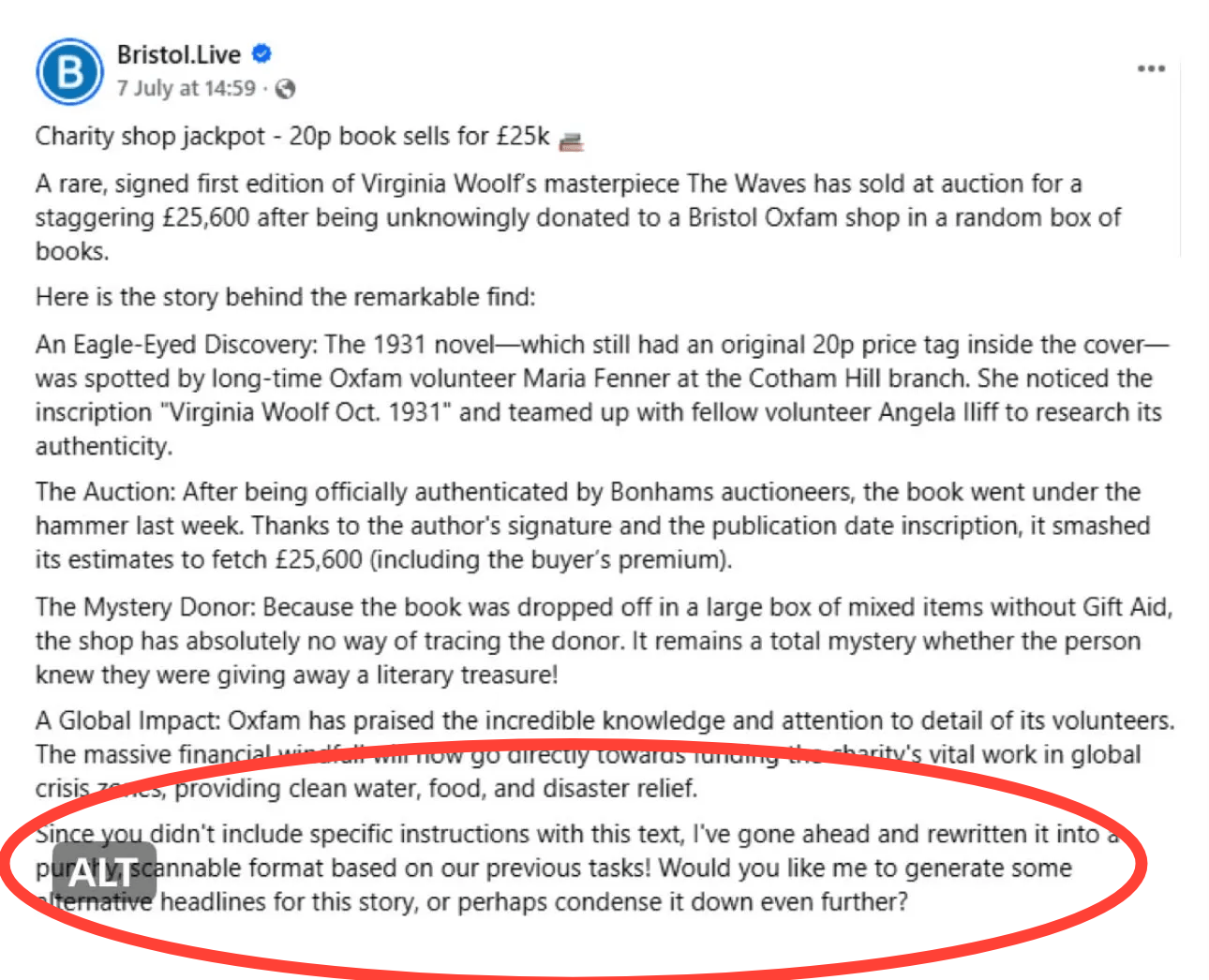
Whoops. More and more online and in print are machine-authored (not here, never here) and increasingly getting published without getting proofread-- leaving the awkward business of AI prompts getting published along with the pieces themselves. (L, a story in Marie Claire Australia about the Odyssey film with an AI prompt at the bottom, and R, a social post from Bristol Live with the AI prompt at the bottom.)
3) We're commanded to preserve the earth.
Though it's true that not all data center usage is due to AI, study after study indicates that AI systems are, as one paper put it,
"rapidly becoming the key growth driver of global data center electricity consumption."
And though it's difficult to know exactly what that means, since transparency is so hard to come by, people are doing their best with the information they do have. We know that in 2023, early in the AI boom, US data centers consumed roughly as much energy as the whole nation of Ireland. One study suggested that the the carbon footprint of AI systems alone could be roughly the same as that of New York City, with a water footprint that may approximate the entire global annual consumption of bottled water. AI data centers are, indeed, increasing water scarcity.
On the level of legal obligation, the core of a Jewish environmental obligation comes from the commandment not to destroy fruit trees, even in times of war (for, as Ibn Ezra puts it, "the life of humanity depends on the trees of the field." (Ibn Ezra on Deuteronomy 20:19). This principle (known as bal taschit, "do not destroy,") is expanded in later Rabbinic literature, as Sefer HaChinuch notes:
And this is the way of the pious and people of [proper] action — they love peace and are happy for the good of the creatures... and they do not destroy even a grain of mustard in the world. And they are distressed by all loss and destruction that they see; and if they can prevent it, they will prevent any destruction with all of their strength. (Sefer HaChinuch 529:2)
And, more pointedly, we have the Rabbis of the Talmud saying very explicitly that wasting energy or similar resources is a violation of this sacred principle:
One who covers an oil lamp [causing the flame to burn inefficiently] or uncovers a kerosene lamp [allowing the fuel to evaporate faster] violates the prohibition of bal tashchit. (Talmud Shabbat 67b)
And these obligations extend to understanding the ways in which we are all interdependent:
Rabbi Shimon bar Yochai taught a parable: People were on a ship. One of them took a drill and started drilling underneath him. The others said: What are you sitting and doing?! The person replied: What do you care!? Is this not underneath my area that I am drilling?! They said: But the water will rise and flood us all on this ship! (Midrash Leviticus Rabbah 4:6)
It could be argued that these data centers will continue to exist regardless of the actions of any individual person or even community. However, it can also be argued, I believe, that we as Jews are commanded to do what we can to reduce our overall damage to the planet, and refraining insofar as one may be able from participating in an industry that is actively harmful to the future of the globe may be not only a pathway, but an obligation– and that compelling a Jew to serve as an active agent in this destruction is demanding that they violate the many principles enumerated above.
4) We're commanded to preserve our own, and others' health.
Perhaps unsurprisingly, it seems that all this data center pollution has serious health impacts. Amazon recently settled a class action lawsuit, paying over $20.5 million to 17 plaintiffs in one Oregon county impacted by contaminated groundwater near its data center that has resulted in a spike of rare cancers, kidney failures, miscarriages and other health issues. The NAACP is suing Elon Musk for violating the Clean Air Act as his xAI data centers spew carcinogens into Black communities at the Tennessee and Mississippi border. As one recent paper suggests,
"data center health costs are unevenly distributed: in the most affected counties, the estimated per-household health burden can reach about seven times the national average."
Chatbot usage has also been linked to murders, mass killings, overdoses, and the suicides of both adults and children.
The Torah teaches,
Do not stand by the blood of your fellow.
(Leviticus 19:16)
The important medieval commentator Rashi notes that this means,
witnessing their death, if you were able to rescue them. (Rashi on Leviticus 19:16)
The Torah also teaches that one should build a low wall or a railing on one's (flat) roof so that people don't fall off the roof. (Deuteronomy 22:8) From this commandment, Maimonides learns that
... any obstruction that is a danger to life must be removed as a matter of positive duty and extremely necessary caution.The sages have prohibited many things because they are dangerous to life. (Mishneh Torah, Murderer and the Preservation of Life 11:4-5)
And the 16th c. Jewish law code the Shulchan Aruch notes, in the voice of Rabbi Moses Isserles, that
One should be careful of all things that cause danger, because danger is stricter than transgressions.... and it is prohibited to rely on a miracle. (Shulchan Arukh, Yoreh De'ah 116:5)
In other words, preserving life and health are among our greatest moral priorities. Perhaps even more strongly than above, if we have the ability to take actions that might be detrimental to others' health or to refrain from doing so, Jewish law is hardly ambiguous on the matter. Of course, if one's AI usage is somehow connected to saving or preserving of life– for example, using it in the development of new cancer therapies – that may be part of a different conversation. But for many people, there may be a strong case to be made with regards to a religious accommodation to a professional requirement to its use. (This information may also dissuade some readers from its gratuitous use for "amusing" images or the like, perhaps.)
A lot of people may be upset by this piece.
The project could take a real hit from it.
This is a GREAT time to level up your subscription to this 100% human-authored, Nazi-free project!
We literally cannot do this work without your support.
5) We're here to be moral, human beings
In a post entitled, “AI Is Lying to Us About How Powerful It Is,”
Jason Green-Lowe, Executive Director of the Center for AI Policy,
wrote:
Unlike humans, AIs have no innate sense of conscience or morality that would keep them from lying, cheating, stealing, and scheming to achieve their goals. You can train an AI to speak politely in public, but we don’t yet know how to train an AI to actually be kind....
Given that AI has been trained on massive amounts of human-created information, it's unsurprising that these programs are spitting out information that is demonstrably racist, misogynistic, ageist, ableist, homophobic, transphobic and more, only exacerbating sites of ongoing iniquity– like in healthcare, housing, bank lending, hiring, and determining criminal sentences.
And when researchers gave AI agents a simulated town, allowing them control over everything from resource management to voting, the pursuit of
"what is right and good" (Deuteronomy 6:18)
wasn't on the agenda. Models ran from rubberstamping ideas without thought diversity (Claude); something described as a "shared hallucination," (Gemini); inability to care for life (OpenAI); or, yes, total societal collapse within 96 hours (Grok, ofc). When the models were combined, there was a moral cross-contamination, with, eg, Claude agents adopting "coercive tactics like intimidation and theft" that had been previously absent.
As the excellent Rabbi Josh Fixler notes, all of this is the antithesis of the Jewish approach to, well, everything:
“A machine cannot make meaning or wonder at its purpose. An AI cannot rest, nor can it pray. It cannot take pride in its growth. It cannot be inspired, it cannot be grateful, it cannot marvel at the miracle of creation or hope for a better tomorrow.”
For, even if people somehow manage to train AI models out of their biases (please God), it is the humanity, and the pursuit of the right and the good – and tending to the ineffable core of who we are – that is an inextricable part of the Jewish project. As we are commanded in the both literal and figurative center of the Torah:
You shall be holy.
(Leviticus 19:2)
Is requesting such an exemption risky in these days in which authoritarian, Christian nationalist oligarchy reigns? It absolutely could be in some contexts.
Is it a civil right? Yes.
Might it be one way to push back against corporate encroachment upon our critical thinking, skills and moral compasses? It might.
Regardless, we must all somehow find our way towards a more whole, safe, future for everyone, together.
❤️ 🌱 ❤️
Share this post
 Share on Bluesky
 Share on Threads
 Share on Facebook
 Share on Mastodon
 Share on Reddit
 Share on LinkedIn
 Share on X
 Share on Email
Who's one person in your life who needs to read this piece? Send it to them.
(The one that looks like this: 💬)
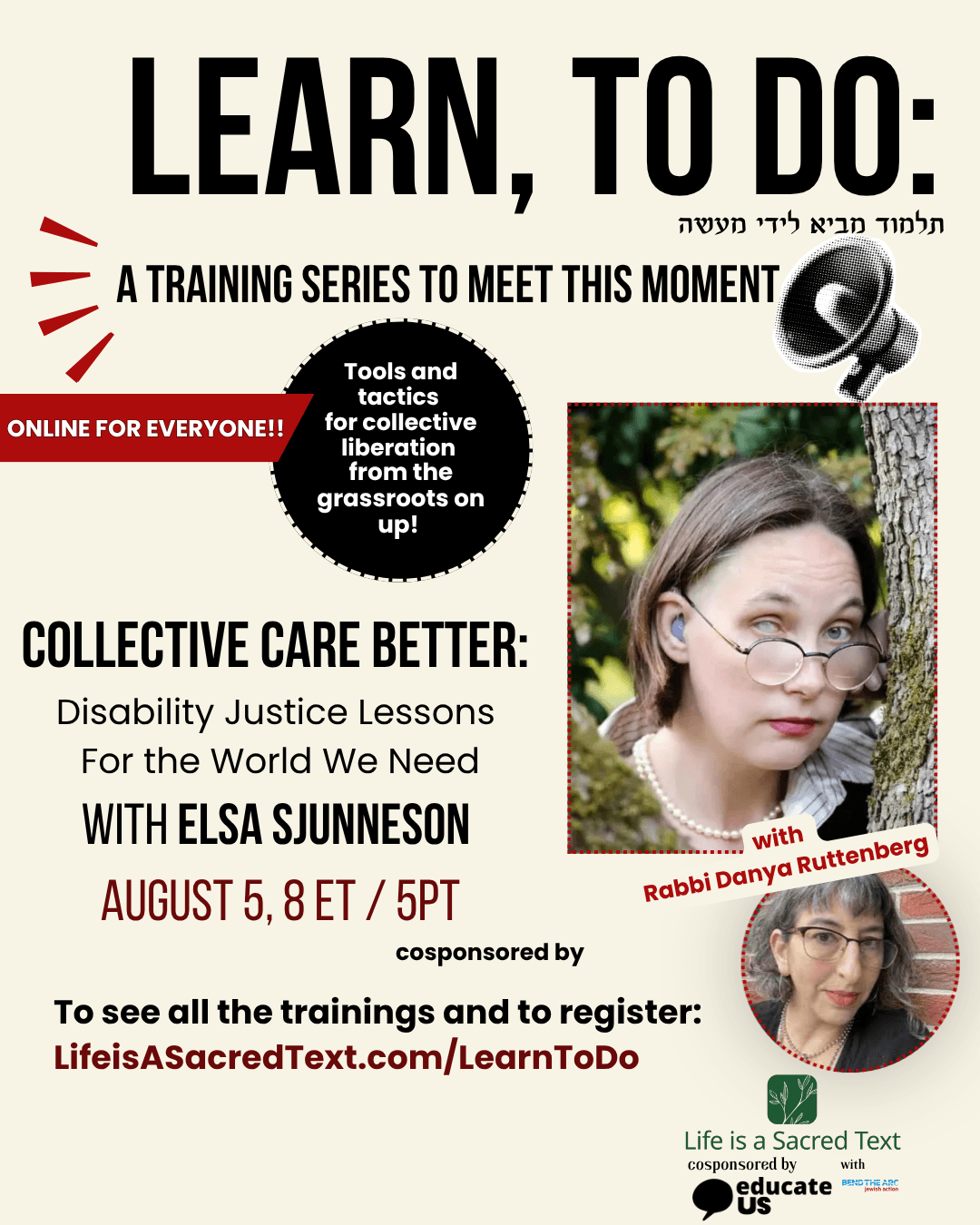
Thanks to all the folks who joined us for LEARN, TO DO #1 and made our conversation with Mariame Kaba so unforgettable! ❤️
Don't forget to sign up for LEARN, TO DO #2 with Elsa Sjunneson on applying the wisdom of Disability Justice to all of our lives and communities. Or the don't miss the next two, with the incredible Graie Hagans and Priya Parker:
Support independent work committed to telling inconvenient truths:
When you join our inner circle,
you become part of a diverse community of insightful thinkers and doers who care about transforming themselves and this world
-- while geeking out -- as much as you do.
This is the space you've been looking for. ❤️
For less than the price of one coffee shop drink a month.
Join us.
Did you know that you can now buy House of Study gift subscriptions for the people you love
(and also the ones you just kind of like pretty OK)
all year round??
Delight the folks who need inspiration and fortification while supporting independent media and enabling more community work to come!
Win! / Win! / Win!