

This is Life as a Sacred Text 🌱, an everybody-celebrating, justice-centered voyage into ancient stories that can illuminate our own lives. It‘s run on a nonprofit, so it’s 100% NAZI FREE. More about the project here, and to subscribe, go here:

On January 22, 1973, Roe v. Wade was passed: Fifty years ago yesterday.
On June 24, 2022, Roe v. Wade was overturned.
I want to talk about the ways in which abortion bans are, have always been, a violation of religious freedom.
But first, I want to talk about where we are now.
Step one: It’s important to understand that many, many, many people were already without abortion access before last June.
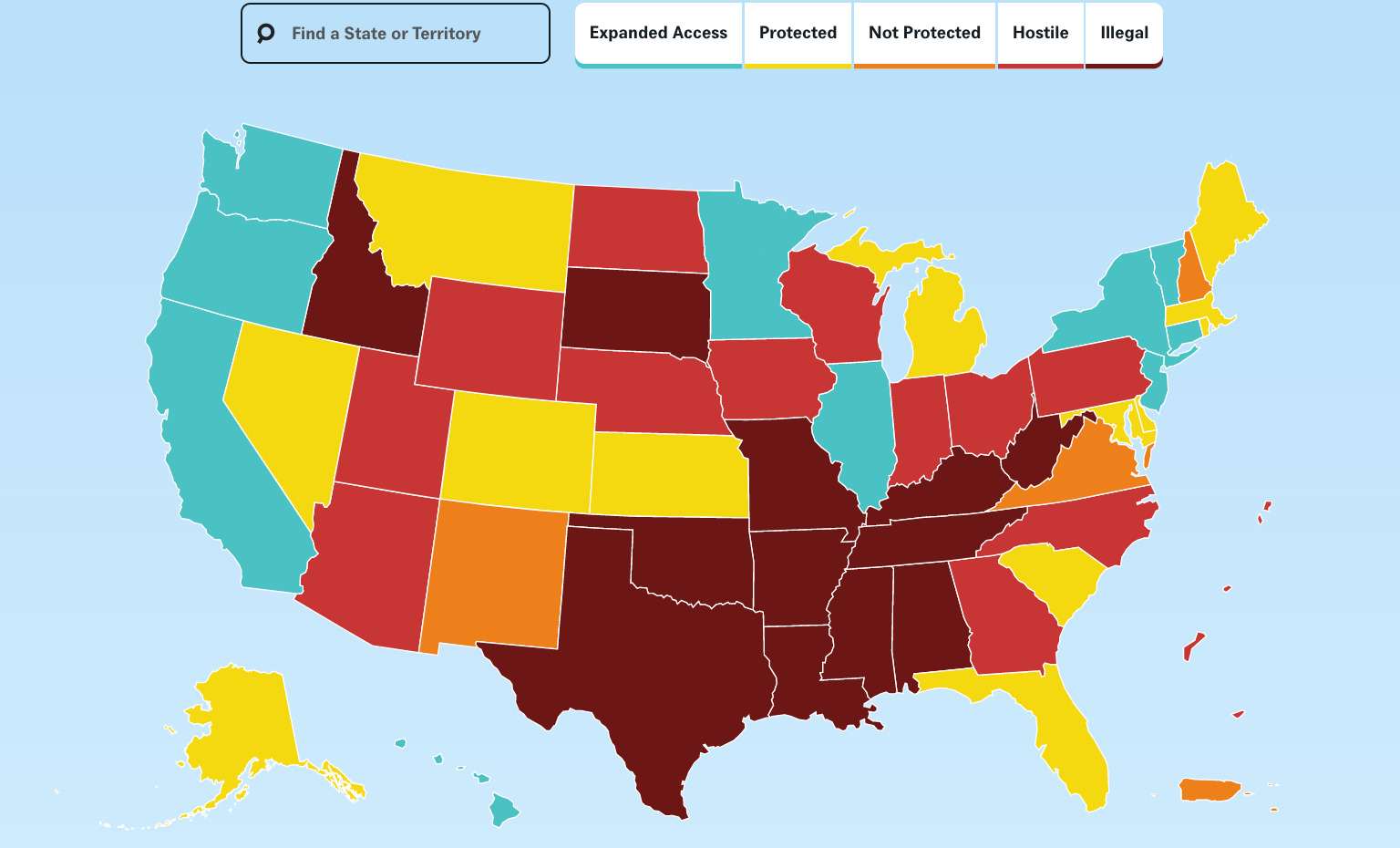
Many people were without access even before our nation’s map looked like this, as it does now:
Since 1976, the racist Hyde Amendment has blocked Medicaid and other federal funding for abortion services; discriminatory public policy has created systemic and economic barriers that mean 30% of Black women and 24% of Latina women ages 15 to 44 are currently enrolled in Medicaid, compared to 14% of white women. This also impacts the roughly 60% of the Indigenous peoples whose healthcare comes from the Indian Health Service (IHS), which operates out of the US Department of Health and Human Services. (A significant number of Indigenous people are also—for the same structural reasons of colonialism and racism—on Medicaid, so that means that a significant percentage of Indigenous peoples under United States governance have had no legal access to abortion care for decades.)
(Allowing Hyde to happen and then allowing Hyde to stay all this time is one of the defining failures of white feminism of these decades.)
Some estimations indicate that over two million—two million—women, trans men, nonbinary people and others have been forced to give birth by the State because of Hyde (and those calculations don’t take into account those who died as a result of pregnancy complications and so forth. Just live births.)
And the last fifty years has been, truly, death by a thousand cuts: over 1000 state and national abortion bans and restrictions were enacted between 1973 and 2022.
Data shows that maternal death rates were 62% higher in 2020 in states with restrictive policies than those without, while from 2018 to 2020 “the maternal mortality rate was increasing nearly twice as fast in states with abortion restrictions.”
Sixty two percent. Increasing nearly twice as fast.
Now calculate that by the fact that 58% of the US population that needs abortion care is currently living in states with no, or little, access.
Bans of course disproportionately impact people who are already marginalized in our society; even before the overturn of Roe, Black women and others who can get pregnant were three times more likely to die from a pregnancy-related cause than white women.
1 in 5 transmasculine people who have ever been pregnant end up resorting to unsafe methods, often after being denied treatment for being trans. Less than a quarter of US abortion clinics are explicitly trans inclusive (more will treat trans people, but it's not guaranteed).
Disabled people have a host of issues related to access and reproductive justice, including also being disproportionately on Medicaid (so: Hyde), difficulty physically accessing care, some having bodies that may be higher risk of forced birth, a long history of forced sterilization that continues into the present (learn about Buck v Bell) and more.
Abortion bans disproportionately impact people struggling financially; BIPOC communities; young people; people in rural communities; immigrants; disabled people; trans and nonbinary people.
People denied abortion access are more likely to live in poverty & stay in abusive relationships. And murder is the leading cause of death for pregnant people, and those immediately postpartum. See: more people trapped in abusive relationships.
Yeah, it’s bad.
In a previous missive on the Jewish approach to abortion justice, I explained WHY abortion is permitted in Judaism—and required in order to save the life of the pregnant person. (Nobody is going to tell me that I didn’t flag this clearly enough!)
 Rabbi Danya Ruttenberg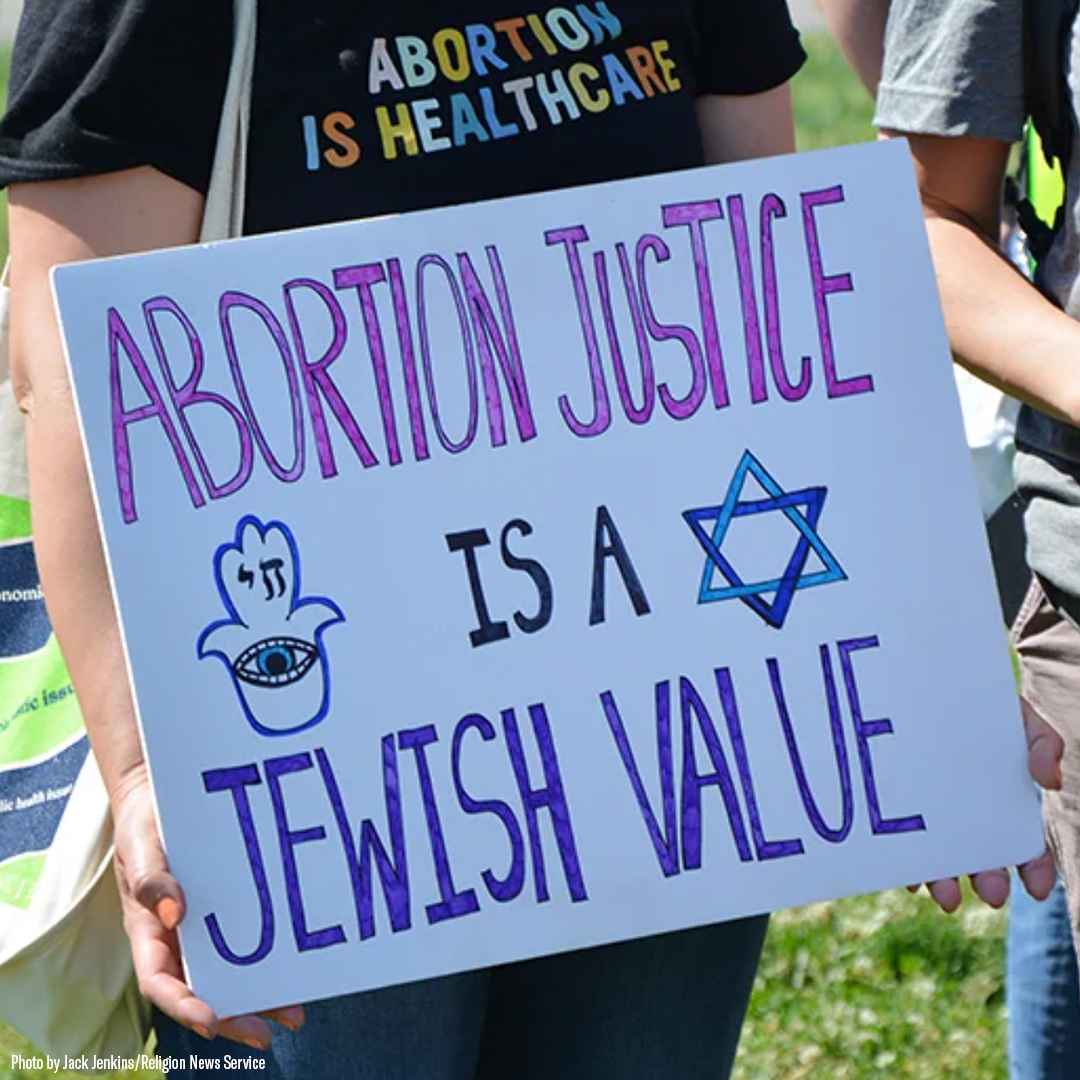
And in The Atlantic in May, I extended, in many ways, the Jewish case for abortion justice:
 Danya Ruttenberg
As it happens, the birth of the Evangelical antiabortion movement is about the creation of a religious understanding.
In order to tell this story, I need to tell it in a few disjointed parts. I’m not sure how else to do it.
I just want y’all to see how this happened “from the inside,” as Jews say about learning primary texts. I think it matters, as we talk about why abortion bans are a violation of the Establishment Clause.
Because, let’s be real: There would be no antiabortion movement if there was no white Christian Evangelical movement.
And at the core of that is the Southern Baptist Conference.
Some tell the story of the antiabortion movement being created in the wake of white Christians losing private school segregation in the Supreme Court in 1976, and needing something to rally voters to the polls, to galvanize the base, now that Jim Crow wasn’t around to do the job. Others talk about a more complex set of factors (opposition to feminism and the bourgeoning gay rights movement, a grassroots movement and, of course, racism) that created this monster.
In any case, a look at the Southern Baptist Convention resolutions on abortion over a few years is… telling. It tells us things. Things are told. Shall we?
Bold is me, for things to particularly pay attention to.
Let’s study text.
Southern Baptist Convention Resolutions on Abortion
Resolution On Abortion, adopted at the SBC convention, June 1971:
WHEREAS, Christians in the American society today are faced with difficult decisions about abortion; and
WHEREAS, Some advocate that there be no abortion legislation, thus making the decision a purely private matter between a woman and her doctor; and
WHEREAS, Others advocate no legal abortion, or would permit abortion only if the life of the mother is threatened;
Therefore, be it RESOLVED, that this Convention express the belief that society has a responsibility to affirm through the laws of the state a high view of the sanctity of human life, including fetal life, in order to protect those who cannot protect themselves; and
Be it further RESOLVED, That we call upon Southern Baptists to work for legislation that will allow the possibility of abortion under such conditions as rape, incest, clear evidence of severe fetal deformity, and carefully ascertained evidence of the likelihood of damage to the emotional, mental, and physical health of the mother
This is the first of the SBC resolutions on abortion that I know of. 1971.
The movement to legalize abortion had begun in the mid-50s, and had begun to speed up in the 1960s, so by the early 70’s, the question of legal abortion was in the popular conversation. This resolution is a reflection of that and, as you can see, above, it is conservative about its sanction of abortion, to be sure, but nonetheless advocates for abortion access not only in cases of trauma or physical concern to parent or fetus, but also concern for the pregnant person’s emotional and mental wellbeing. And notes that it may be a “private matter between a woman and her doctor.”
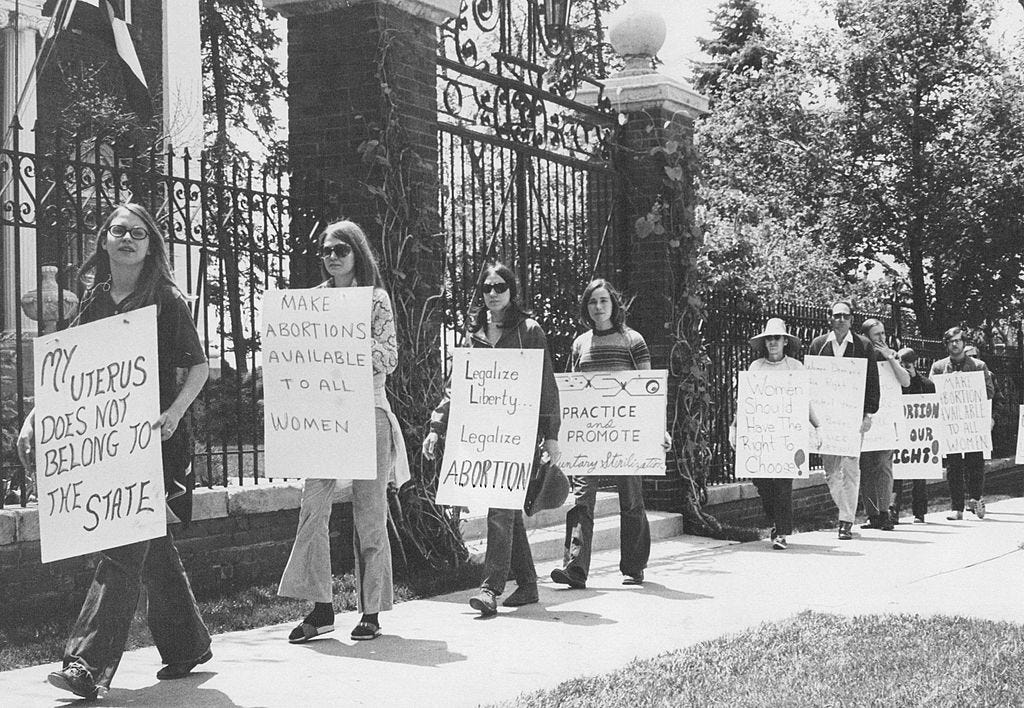
Resolution On Abortion And Sanctity Of Human Life, adopted at the SBC convention, June 1974:
WHEREAS, Southern Baptists have historically held a high view of the sanctity of human life, and
WHEREAS, The messengers to the Southern Baptist Convention meeting in St. Louis in 1971 adopted overwhelmingly a resolution on abortion, and
WHEREAS, That resolution reflected a middle ground between the extreme of abortion on demand and the opposite extreme of all abortion as murder, and
WHEREAS, That resolution dealt responsibly from a Christian perspective with complexities of abortion problems in contemporary society;
Therefore, be it RESOLVED, that we reaffirm the resolution on the subject adopted by the messengers to the St. Louis Southern Baptist Convention meeting in 1971, and
Be it further RESOLVED, that we continue to seek God's guidance through prayer and study in order to bring about solutions to continuing abortion problems in our society.
Hey, Roe was decided in 1973! You got what you asked for!
Uh. We, uh, kind of stand by what we said, but, like, now it feels really controversial? So, um, let’s just, like, pray on that.
And that high view on the sanctity of human life just went up a few rungs.
But still, bottom line: Abortion, legal. Private matter between the pregnant person and the doc, etc. Still. Let's keep going!