
This is Life as a Sacred Text 🌱, an everybody-celebrating, justice-centered voyage into ancient stories that can illuminate our own lives. It‘s run on a nonprofit, so it’s 100% NAZI FREE. More about the project here, and to subscribe, go here:
I'm excited to (re)introduce you to some of the work of the wonderful, badass Elsa Sjunneson–novelist; memoirist; lifelong activist; three-time Hugo Award winner; sometime writer for Marvel Comics; self-described Deafblind hurricane in a vintage dress who will be our next LEARN, TO DO speaker.
What appears below isn't quite like what you'll see in the LEARN TO DO training, which is really about applying the wisdom of the Disability Justice movement in ways that can transform all of us, not only in our understanding of access, but our ways of doing... everything. As Leah Lakshmi Piepzna-Samarasinha wrote in Care Work: Dreaming Disability Justice,
Collective care means .... people feel fine if they get sick, cry, have needs, start late because the bus broke down, move slower... people work from home—and these aren’t things we apologize for. It is the way we do the work... where many of us have often worked from our sickbeds, our kid beds, or our too-crazy-to-go-out-today beds. Where we actually care for each other and don’t leave each other behind.
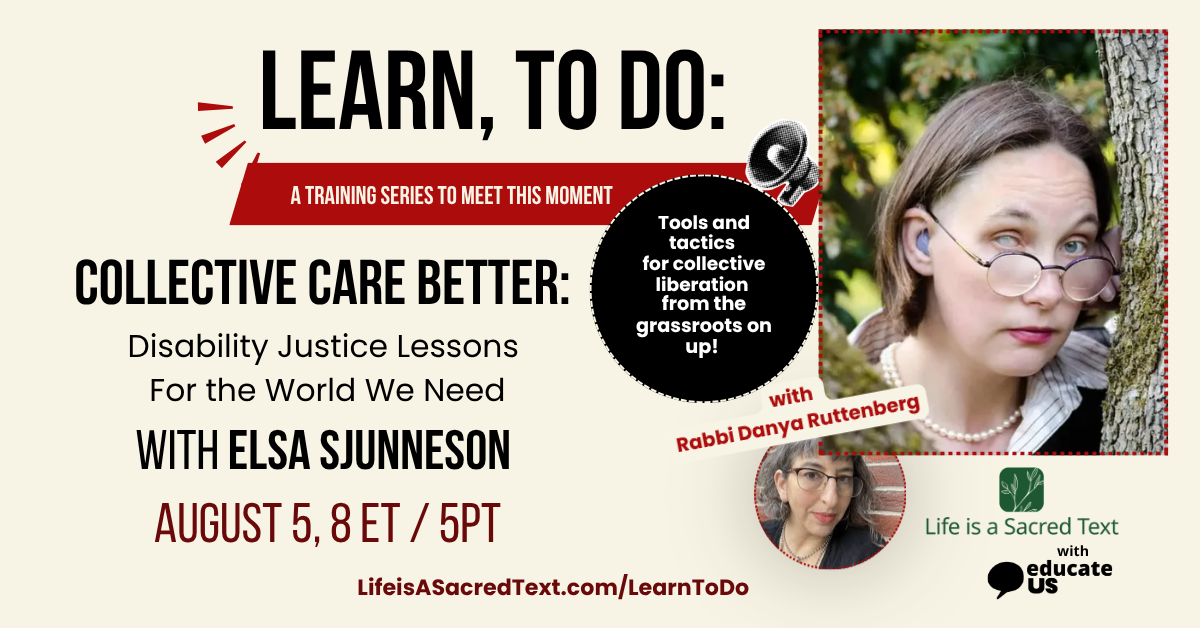
This training is a critical paradigm shift for everyone in community and leadership, so please, register now and don't miss it:
Collective Care Better:
Disability Justice Lessons for the World We Need
August 5, 8 ET / 5 PT
The Disability Justice movement’s visionary ways of approaching community care, sustainability, and leadership offer transformative lessons for everyone. In this practical and inspiring session, Hugo Award–winning author and activist Elsa Sjunneson, of Being Seen and the forthcoming Dear Blind Lady shares the ideas and strategies that help groups weather challenges, support one another, and have long-term impact.

REGISTER NOW!
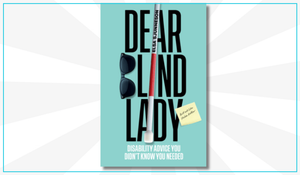
That said, I also want you to just get to know Elsa a bit because she's magnificent, so I'm delighted to share a special preview of her incredible, important new book, Dear Blind Lady Disability Advice You Didn't Know You Needed – which is smart and wise and full of useful, practical advice for everyone (disabled, non-disabled, and newly disabled), as well as being suck-it-down in one sitting readable, as you'll see.
(And remember, 1 in 4 people are disabled, so it's not like this doesn't impact all of us and/or those we love – and will impact all of us in some way. When I say that everyone should get this book, I mean: really, everyone.)
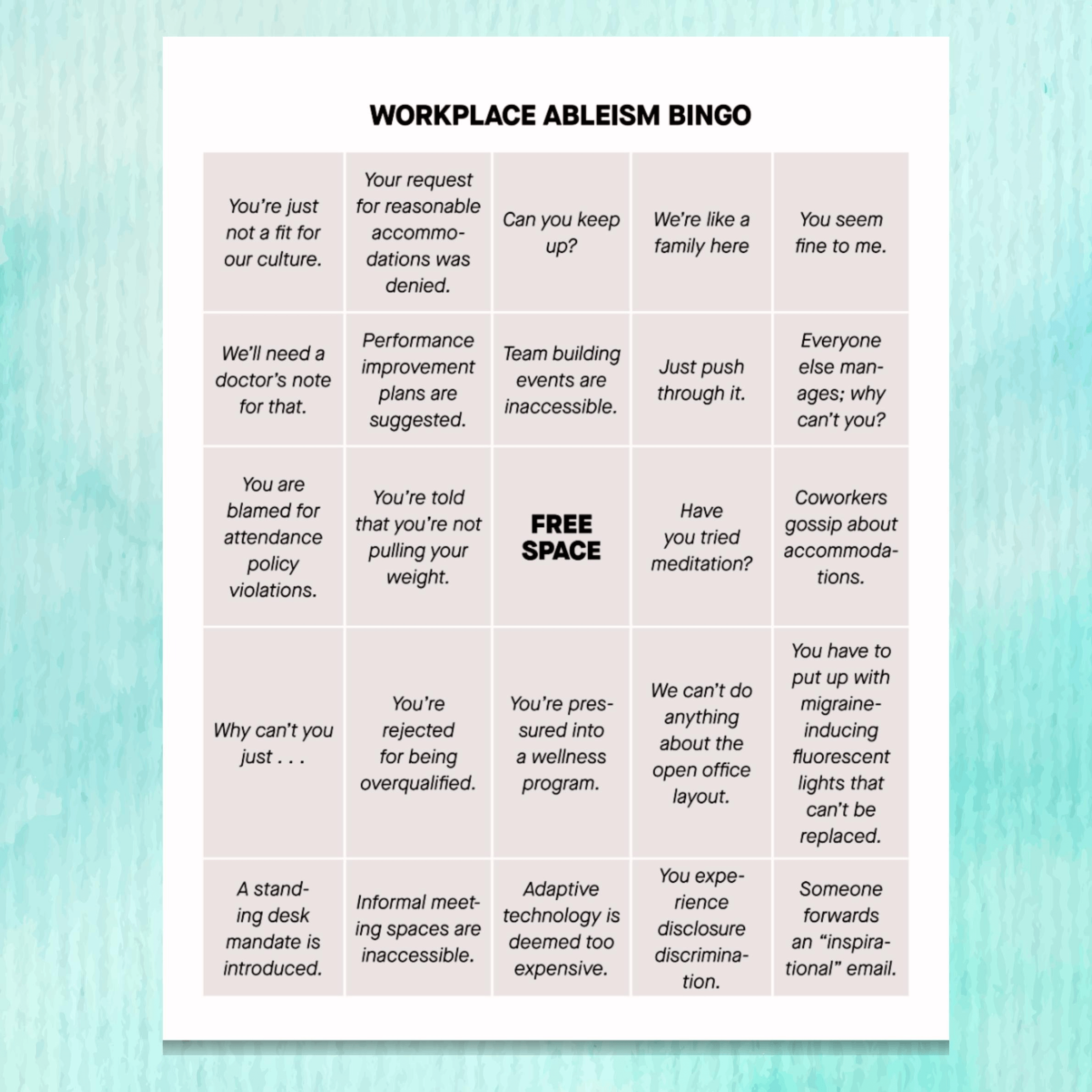
Plus, it's got all sorts of snarky bingo cards, like this.
(We've also got a specially-designed for Life is a Sacred Text bingo card on Torah-related stuff below!)
Some Awkward Moments in Disabled Friendships
Excerpt from Dear Blind Lady: by Elsa Sjunneson:
So let’s say you make friends with a really neat wheelchair user. They’re rad. They like all the same things as you, including D&D! You happen to have a D&D group that meets on Monday nights, and there’s space for a new player. Yay! You excitedly invite them over to play, and they ask if your house is accessible. You assure them that it is. After all, you’re not some kind of demon who would own a home that’s inaccessible to someone you like.
You get home. You start prepping for D&D. And then it hits you. Shame. Horror. Disappointment in yourself. And you have no idea how to fix the problem because when you look outside, you realize that there’s a flight and a half of stairs up to your house and no wheelchair ramp. Shit.
Your first impulse is to grab your phone and text your new friend that you made a mistake and that there actually isn’t any room at the game table, which . . . well, looking around your tiny dining room, you worry that the wheelchair won’t even fit.
Your shame doubles. You can’t let your new friend show up here because then they’ll immediately discover that you lied and had no idea what they would need. So you type. You untype. You stare at your phone. There’s no way out of this.
You then start coming up with other scenarios. Maybe you could carry them up the stairs? You Google that idea and come across multiple think pieces (including one by me) about why you absolutely shouldn’t offer to carry someone up the stairs. You finally realize there’s just no way to get out of this gracefully, so you text them:
“Hey. I’m so sorry. I didn’t really think, and I realized I’m not sure you’ll be able to get inside my house. We can postpone this week’s session if you want, or we could play at a local pub. Is there one you’d suggest?”
Your phone is silent for a few minutes while you pace frantically, convinced that this person is going to end up hating your guts.
Your phone rings.
It’s them.
“Hi!” you say, sounding like a terrified golden retriever.
“Hey, can you send me a picture of the stairs?” they ask.
“Uh . . . sure . . .” You go outside, take the picture, and send it. You also send a picture of your dining room and ask your new friend if they want any other pictures.
“If you don’t mind showing me the bathroom?” they ask. You oblige, silently hoping your bathroom is OK.
“OK, we’ve got two options,” your new friend says. “I can probably make it up your stairs with some help, but you or another player will need to carry my wheelchair up the stairs. It might take me like ten to fifteen minutes to get up them, but I can do it. Or we can go to Kangaroo & Kiwi. It’s game friendly, so we could go there this week while we see if someone else can host? I’d be happy to; I just need to check with my roommates.”
This . . . is not what you were expecting.
“Oh . . . sure. Uh,” you stammer. “Since we’re already set up for this week, want to come here and see how easy it is? If it doesn’t work, we can figure something out for next time if you want to keep playing.”
“Sounds great! I’ll see you at five!”
By letting your friend Choose Their Own Adventure, you’re giving them the same autonomy that you give every player in your D&D sessions. You’re letting your friend choose their own path; the one that makes the most sense for them.
As it turns out, you hadn’t thought about the driveway in back, which has a shorter stairwell, and your friend was able to get up just fine with a few steps to the deck...and then their chair got stuck in the doorway, which made everyone laugh. You figured it out. Everyone had a good time. And you fought a mimic together.
Most people panic when they realize they’ve screwed up an accessibility issue, rather than being honest. I think that’s one of the reasons it’s so hard for nondisabled people to make friends with disabled people: They’re afraid of screwing up.
The fact is that you can swap almost any disability and any invitation in this scenario. You invited your blind friend to a restaurant that doesn’t have a braille menu. You invited a friend who has a seizure disorder to a show but didn’t check if they use strobe lights or fog. Screwups happen. What matters is how you own up to your screwup and what you learn from it.


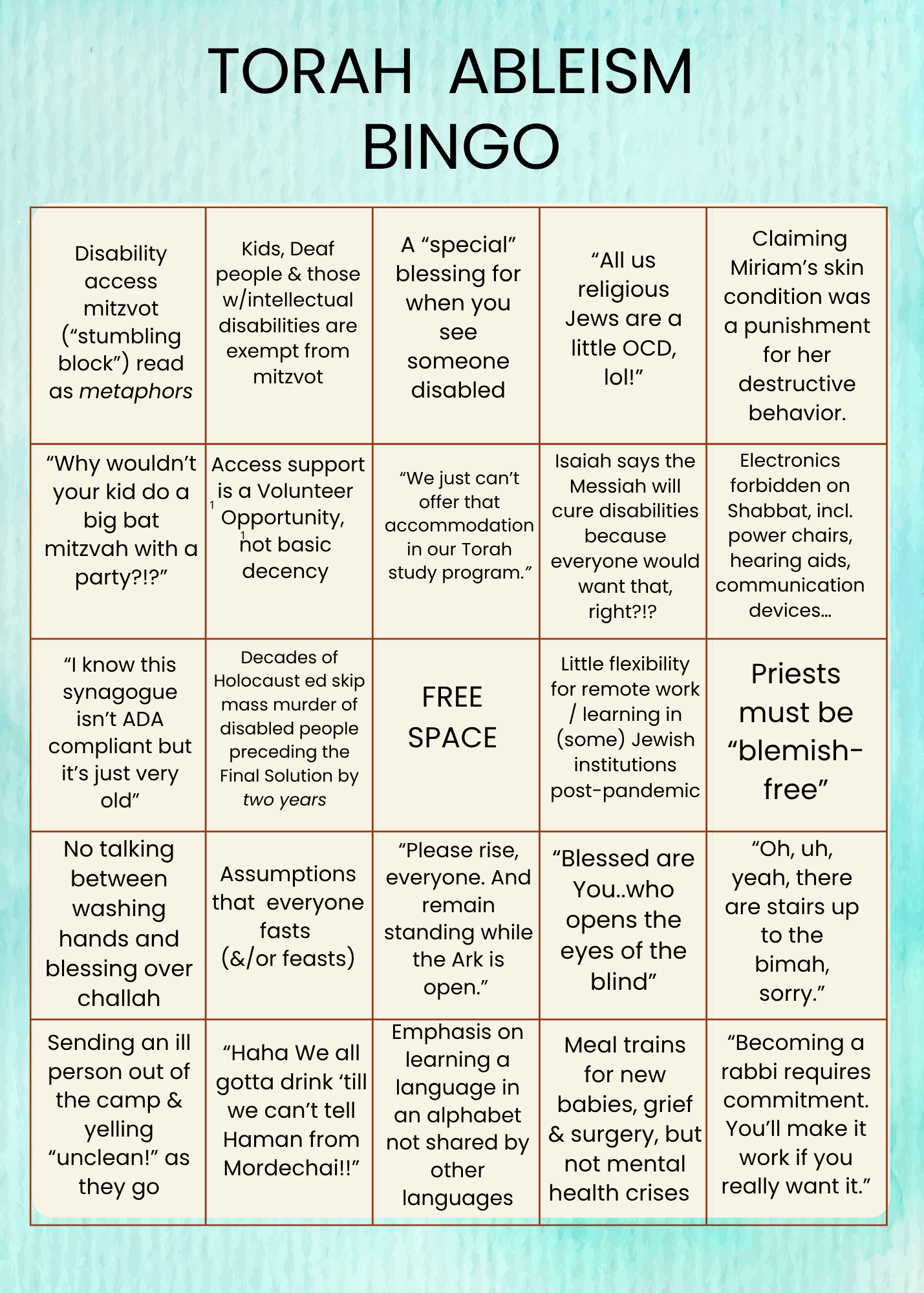
Since not everyone has context for all of these, the key to:
TORAH ABLEISM BINGO
- Disability access mitzvot ("stumbling block") read as metaphors"
- Why wouldn't your kid do a big bat mitzvah with a party?!?"
- "I know this synagogue isn't ADA compliant but it's just very old."
- No talking between washing hands and blessing over challah
- Sending an ill person out of the camp, yelling "unclean!" as they go
- Kids, Deaf people & those w/intellectual disabilities are exempt from mitzvot
- Access support is a Volunteer Opportunity, not basic decency
- Decades of Holocaust education skip the sterilization and then mass genocide of disabled people, preceding the Final Solution by eight and two years, respectively
- Assumptions that everyone fasts (&/or feasts)
- "We all gotta drink 'till we can't tell Haman from Mordechai lol!!"
- A "special" blessing for when you see someone disabled (oh yes, this whole passage is so, so problematic on so many levels)
- "We just can't offer that accommodation in our Torah study program."*
- FREE SPACE
- "Please rise, remain standing while the Ark is open."
- Emphasis on learning a language in an alphabet not shared by other languages
- "Oh, all religious Jews are a little OCD, lol!" 😒
- Isaiah says the Messiah will cure disabilities because everyone would want that, right?!?
- Little flexibility for remote work / learning in (some) Jewish institutions post pandemic
- "Blessed are You..who opens the eyes of the blind."
- Meal trains in the community get put together regularly when people have new babies, are experiencing grief & recovering from surgery (all important!!), but there's often an absence of communal care and surplus of awkwardness in many spaces when people are undergoing mental health crises or other less socially acceptable struggles
- Rabbinic claims that Miriam's skin condition was a punishment for her destructive behavior.
- Electronics are forbidden on Shabbat viz some interpretations of Jewish law, which may include power chairs, hearing aids, communication devices...
- Priests must be "blemish- free."
- "Oh, uh, yeah, there are stairs up to the bimah, sorry."
- "Becomong a rabbi requires commitment. You'll make it work if you really want it.”* 🙄
Curiosity Doesn’t Kill Friendships or Cats
from Dear Blind Lady by Elsa Sjunneson
The other real winner in friendships is curiosity. I don’t mean curiosity in the “sidle up to your friend and finally ask what’s wrong with them” way but in the “ask genuine questions that deepen your friendship” way. Most of my friends don’t ask questions. Most of my friends assume they know everything about me because I wrote a memoir or because I live loudly and in public. The truth is, though, that my experience shifts depending on the situation.
Whether you’ve known a disabled person for twenty years or two minutes, there are always new things to learn, and that’s partially because disability isn’t static. Yes, disabled people age just like nondisabled people do. I started out needing only one hearing aid when I was eight, but now, at almost forty, I’m wearing bilateral hearing aids, and my hearing is definitely worse. My sight is . . . weird. I didn’t start out with PTSD, but I acquired it. I’ve had bad chronic pain my whole life thanks to a heart surgery scar, but it’s definitely worse now as an almost forty-year-old but not as bad as it was when I was twenty-eight. Disability changes, and so do the ways we cope.
Friendships thrive on learning about each other over time. So take the time to really understand where your disabled friends are right now. Not twenty years ago, not fifteen years from now, but in this moment. What do they need to feel safe, comfortable, and seen right now?
❤️ 🌱 ❤️
Who's one person in your life who needs to read this piece?
Share this post
 Share on Bluesky
 Share on Threads
 Share on Facebook
 Share on Mastodon
 Share on Reddit
 Share on LinkedIn
 Share on X
 Share on Email
Send it to them.
(The one that looks like this: 💬)
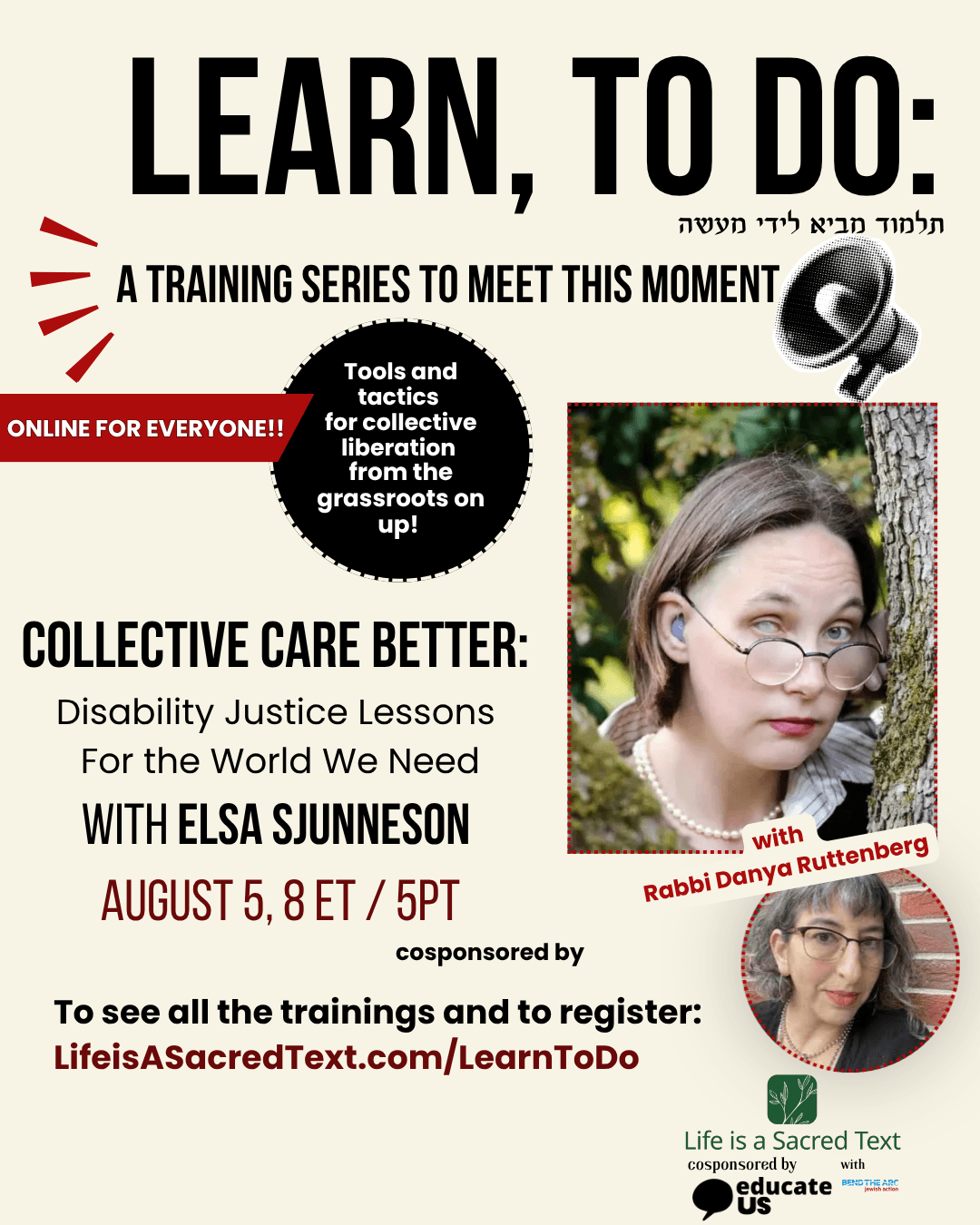
Thanks to all the folks who joined us for LEARN, TO DO #1 and made our conversation with Mariame Kaba so unforgettable! ❤️
Don't forget to sign up for LEARN, TO DO #2 with Elsa Sjunneson on applying the wisdom of Disability Justice to all of our lives and communities. Or the don't miss the next two, with the incredible Graie Hagans and Priya Parker:
MORE:
 Rabbi Danya Ruttenberg
 Rabbi Danya Ruttenberg
 Rabbi Danya Ruttenberg
When you join our inner circle,
you become part of a diverse community of insightful thinkers and doers who care about transforming themselves and this world
-- while geeking out -- as much as you do.
This is the space you've been looking for. ❤️
For less than the price of one coffee shop drink a month.
Join us.
Support independent work committed to telling inconvenient truths: