
This is Life as a Sacred Text 🌱, an everybody-celebrating, justice-centered voyage into ancient stories that can illuminate our own lives. It‘s run on a nonprofit, so it’s 100% NAZI FREE. More about the project here, and to subscribe, go here:

Today we're going back into the Prophets, to look at a set of stories that's had a real impact on our thinking and tropes over the centuries– only to discover that they're more morally nuanced than often considered.
Rahab: Traitor to her people? "Sex worker with a heart of gold?"* Faithful follower of God? Or something far more complex and strategic? Where does the (actual) geologic history of Jericho‘s walls fit in? And how is this story an extended Exodus metaphor?
*The implication of this outdated trope being that it would be notable for someone who exchanges labor/services for remuneration to be kind-- even, or especially, if that person is engaged in work that is reviled by society (even as many members of that society make use of that person's work).We're back today in the Book of Joshua, whose problematic larger conquest themes we addressed through Daniel Delgado's lens of right relation and the big picture of the arc of exile. And we've long established that the conquest narrative didn't really happen the way these stories describe it (but that, really, the Israelites and the Canaanites had shared origins). Today we're going into storytime, though:
To catch us up: The Book of Joshua opens right at the end of the Torah narrative:
"After the death of Moses... God said to Joshua son of Nun... "Prepare to cross the Jordan, together with all this people..." (Joshua 1:1-2)
Josh decides to start off conquering the land and all its people (!) with a little reconnaissance mission, not unlike the story of the spies/scouts back 40 years earlier. So he sends two guys in to check out Jericho (not more than 6 miles away from the river).
Jericho, now in the West Bank, is one of the oldest cities in history, with evidence of settlements dating back to at least 9000 BCE.* Some of its fascinating history is relevant as we go.
*Its name, ירחו, shares a root with a number of other Ancient Near Eastern words-- like "moon" and "fragrance"-- so the place's etymology is unclear..So we get to Joshua Chapter 2:
Joshua son of Nun sent two men as spies, saying, “Go look over the land, especially Jericho." So [these two unnamed spies] set out, and they came to the house of a certain sex worker named Rahab and slept there.
Rahab is named as a sex worker in her first verse, and there are not one but two words innuendo'ing that the spies did more than just snooze at her house. The word for "came to" בואו /bou is also used as a technical word for sex, and ישכבו/"to sleep with" there, as today, can mean literally or– not. Again, nothing stated outright, but it's implied, and Rahab's job is sandwiched between these suggestive words chiastically. (Great reconnaissance, boys.)
Then? Get the popcorn:
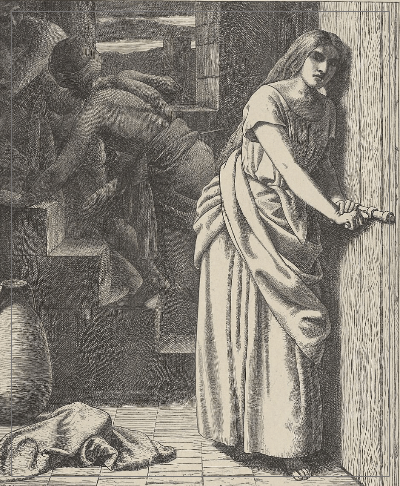
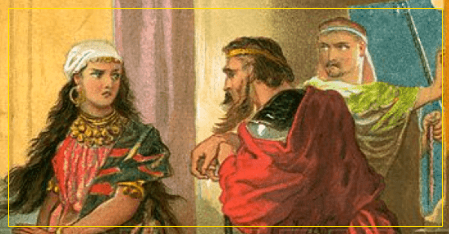
The king of Jericho was told, “Some men have come here tonight, Israelites, to spy out the country.” The king of Jericho thereupon sent orders to Rahab: “Produce the men who came to you and entered your house, for they have come to spy out the whole country.”
Nobody points out that these dolts risked their mission and potentially their entire community with this brothel visit, but ...!!?!?!!.
But luck is on their side:
The woman, however, had taken the two men and hidden them.
“It is true,” she said, “the men did come to me, but I didn’t know where they were from. And at dark, when the gate was about to be closed, the men left; and I don’t know where the men went. Quick, go after them, for you can overtake them.”
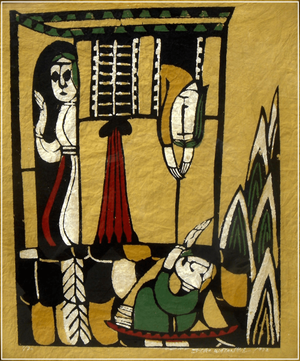
Now she had taken them up to the roof and hidden them under some stalks of flax that she had lying on the roof.
So the men pursued them in the direction of the Jordan down to the fords; and no sooner had the pursuers gone out than the gate was shut behind them.



When you join our inner circle,
you become part of a diverse community of insightful thinkers and doers who care about transforming themselves and this world
-- while geeking out -- as much as you do.
This is the space you've been looking for. ❤️
For less than the price of one coffee shop drink a month.
Join us.
We have a non-Jewish king who demands that a woman obey him – and she lies to his face in order to save Jewish lives. Kind of a callback to the midwives Shifra and Puah subverting Pharaoh at the beginning of Exodus.
But here, the stakes are far from the same– after all, isn't she betraying her own people and allowing a foreign army to come slaughter them?!?
We'll address that in a moment. First:
She came up to [the spies] on the roof. She said to the men, “I know that God has given the country to you, because dread of you has fallen upon us... Now, since I have shown loyalty to you, swear to me by God that you in turn will show loyalty to my family. Provide me with a reliable sign that you will spare the lives of my father and mother, my brothers and sisters, and all who belong to them, and save us from death.”
"I got those guys off your backs, now give me proof that you've got my back." I'm condensing this speech, but she also mentions the Red Sea parting as proof of God's impressiveness–notable given other Exodus echoes in this story.
(Some scholars argue that the whole story's meant to be funny – the spies shirk their duties only to wind up at the only pleasure house in town where the sex worker invokes God's Exodus miracles...!)
The spies say that if she keeps their secret, they'll take care of her.
She let them down by a rope through the window—for her dwelling was at the outer side of the city wall and she lived in the actual wall.
Ancient cities were protected by walls, and some were fortified by double walls, with storehouses, rooms and more tucked in between. She lived inside the Jericho walls– literally on the margins of the city.
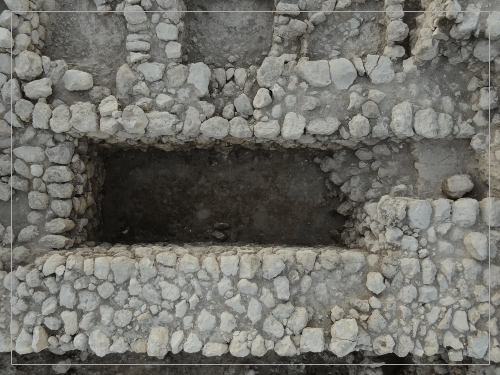
Contextualizing Rahab as a character who is already marginalized by her own community, doing work that indicates her profound lack of privilege, helps illuminate her choices.*
*Assuming we'd like to read beyond the Deuteronomist narrative of, "Canaanite woman becomes quickly faithful to the Israelite deity and is thus down to abet the slaughter of Those Pagans™️," which I, for one, would.South African Bible scholar Sheurl Davis, reading from a postcolonial feminist perspective, untangles much of the binary thinking that has dogged this story in the past. She invites us to consider
the possibility that [Rahab] did not know which way the battle would go, and dealing with the spies was a way of hedging her bets for herself and her family – if the Canaanites won, she and hers were safe, and if the Israelites won, she and her family were safe... furthermore, her response to the king’s men could have been a reaction to possible previous hostile encounters with these men.
We don't know how much of her misdirection of the king's soldiers was personal, but Davis' implication that there might be history here makes sense. And her suggestion that Rahab's dealmaking isn't picking sides so much as buying insurance is truly insightful.
What if we read Rahab as savvy and strategic, as working the men on all sides since none of them are truly on her team?
Davis concludes,
"Rahab is not a traitor but a survivor, a woman making a way out of no way."
As a woman with relatively few options in her life, when presented with an opportunity just as crisis is about to descend upon her city, she grabs it and plays ball.
After extracting the spies' promise, she lets them go; they tell her on the way out that her family should be with her when things go down, and to tie some crimson cord to the window as a sign to be rescued, evoking the Israelites' smearing lamb's blood on their doorposts so the Angel of Death knows which houses to skip in the Exodus story. (Everything in the Bible rhymes!)
Fast forward a couple of chapters, and Joshua & co are finally going after Jericho– starting of course, with the walls. God tells Josh to do a ritual with the magic number seven:
Let all your troops march around the city and complete one circuit of the city. Do this six days, with seven priests carrying seven ram’s horns/ shofarot preceding the Ark [of the Covenant]. On the seventh day, march around the city seven times, with the priests blowing the horns. And when a long blast is sounded on the horn... all the troops shall give a mighty shout. Thereupon the city wall will collapse, and the troops shall advance....” (Joshua 6:3-5)
The shofar was used to gather the people together, at the beginning of New Moons and other sacred times, in Temple ritual, and yes, to mark the beginning of a battle or war.
As I mentioned earlier, Jericho-the-city is one of history's oldest. And it was built on... an earthquake fault line, now known as the Jericho Fault.
Evidently a violent earthquake struck in the Early Bronze Age (ca. 2700 BCE) requiring the city to be completely rebuilt. By the Middle Bronze Age, it was a major urban center with... yep, extensive defensive walls. Scholars conclude that it was destroyed again in 1550 BCE, by a massive fire. This doesn't seem to have been connected to war, as there weren't enough weapons or corpses involved, but some have noted that fires often follow earthquakes, even today– one lamp or torch needed to be knocked over and the whole city could have been engulfed.
Over time, Jericho's residents adapted their building techniques to earthquakes, though likely other attempts at rebuilding were thwarted by smaller earthquakes, too. By the Iron Age it had become a decent-sized town, only to be destroyed by the Babylonian conquest in the late 6th c. BCE.
Archeologist Lorenzo Nigro suggests that the biblical wall story might have evolved through the collective local memories about what happened in the 3rd and 2nd millennia BCE (and, I might suggest, those smaller, more recent quakes).


But that's where Rahab lived. Literally on the fault lines. On the site of failures and historic vulnerability.
Because regardless of history or lore– not that we'll ever know – just before the walls came-a tumblin' down,
the young spies went in and brought out Rahab, her father and her mother, her brothers and all that belonged to her—they brought out her whole family
"brought-out." Yep, same word used to bring out the Israelites from Egypt.
She's first left "outside the camp of Israel." Then, once the Israelites win, "she dwelt among the Israelites—as is still the case." (Joshua 6:23, 25)
So Rahab is taken from the margins of the city, and her society, first to the edges of the camp, and then to the center of the camp. From margins to center.
She played both sides of a game that was never meant for her. She did not, could not try to save all of her people, like Esther or Judith, or even Delilah. She didn't take a bold stance like Vashti or Lilith or, arguably, Eve.
Rahab saves her own, stealthily–like Yocheved, Moses' mother, who cannot change all of Pharaoh's edicts and systems, but does what she can from her own oppressed position to save what life she can.
The Rabbis teach (Talmud Megillah 14b) that Rahab is an honored foremother to nine prophets.
In the wake of her own personal Exodus– a story of marginalization, of strategy and savvy and scrambling for survival– she engenders a line of people committed to telling the holy truth and calling forth a more just world for everyone.
Share this post
 Share on Bluesky
 Share on Threads
 Share on Facebook
 Share on Mastodon
 Share on Reddit
 Share on LinkedIn
 Share on Email
Who's one person in your life who needs to read this piece?
Send it to them.
Need some words about Life is a Sacred Text to make it easier?
How about:
- "This helps me make sense of the world when everything feels overwhelming.”
- “This is where I go for smart, humane takes on what’s happening right now.”
- “This blends history, justice, and being human in a way I haven’t found anywhere else.”

Zoom Salons are back! With a new time, and a new tack.
Starting June 14th (5ET / 2 PT), we’ll be going deeper and stranger into some of our messiest Monday missives.
It's a chance to unpack, to get new midrashic, mystical and scholarly takes, and jam together on the possibilities these essays open up for us.
And yep, June's topic will be Rahab, because this post just scratched the surface, let alone addressed how she lingers on in our culture today.
House of Study Members get full access.
If you’re only here for the Monday posts— we’d love to have you join the House and this conversation.
*No background knowledge of any kind needed! Just come!
Support independent work committed to telling inconvenient truths:
RELATED
 Rabbi Danya Ruttenberg
 Rabbi Danya Ruttenberg
 Rabbi Danya Ruttenberg